I don’t know where that phrase comes from, but it’s always associated with the passing of a beloved pet. We knew that time was coming for Max, our Great Pyrenees rescue who had surpassed the average GP lifespan by two years already. He was losing weight and drinking a lot of water, which suggested diabetes. However, blood glucose tests showed normal blood sugars. He was just getting old, and probably had some other problems, but what’s the vet going to say? Lab work. Meds. And he’s really old.
I’d repeatedly suggested to Aaron that it might be time to put him down, but as far as we could tell, Max wasn’t in pain. Yeah, he moved a little slower. I move a little slower. I’m not ready to take that dirt nap yet.
So Aaron dug the hole with the tractor, but wasn’t comfortable doing more than that. We had the supplies a very trusted friend with decades of farm animal experience had recommended. Our Plan A when the time arrived.
Yeah, we had Plan B, too.
Aaron and I left home Tuesday morning for a quick visit with friends before continuing on to Utah on Wednesday to sell books at a preparedness expo for three exhausting days. We stayed with Jared and his wife, and since we weren’t able to visit with them while working the event, opted to stay an extra day, planning to head home Monday morning.
Becky was home holding down the fort. And that’s when Max began his final downward spiral. It started a few hours after our initial departure, but very slowly so Becky figured it wasn’t worth mentioning. Until 12:30 Monday morning. He was suffering.
As recommended, Plan A for Max’s departure from this sphere of life involved a couple of Benadryl tablets to calm him down followed by ether over the nose until he drifted blissfully to sleep permanently. Becky just needed to know where the ether was.
Unfortunately, the ether bottle, which had never been opened (but which always had a strong odor about it so I should have suspected something) had leaked and evaporated. There was only about 2 teaspoons remaining. I hadn’t ever thought to check the contents. The potential for evaporation/leaking hadn’t occurred to me. We hadn’t ever used the ether in the past 10 years, so I wrongly assumed it was still there and usable. Unfortunately, those last 2 teaspoons were nowhere near enough for an extra-large dog. Yes, another bottle was just ordered from Amazon. (I thought about getting a metal bottle like last time, because there isn’t the risk of the bottle breaking. However, I chose the amber glass bottle because I want to be able to see whether the ether is still in there.)
Plan A was no longer an option. We were both hoping there would be some way to avoid the Plan B route, but I wasn’t optimistic.
The overwhelming majority of websites don’t provide any helpful information. “Only a vet can euthanize your dog.”
Benadryl: It would be nice if our pet could just drift off to sleep. This paper suggests a dose of ten 50-mg tablets for a 40-pound dog. (Adjust calculations for your own dog’s weight.) As is often the case, however, swallowing pills won’t work when a dog is seriously ill.
Carbon dioxide chamber: This website offers instructions on creating a carbon dioxide chamber for euthanizing animals less than 2 pounds in weight. So it wouldn’t work well for dogs.
Other websites recommended a carbon monoxide chamber—basically the equivalent of turning the car on and closing the garage door. It seems a bit risky to me, and besides, you wouldn’t be able to be with your pet.
The original Plan B would have to be enacted. Becky retrieved her pistol while I searched for the specifics. The following comes from the Internet Center for Wildlife Damage Management.
The muzzle of the gun should be 1.5 to 2.0 inches from the animal’s brain when using a .22 cal long-rifle mushroom shell or a .410 shotgun with slugs or pellets. The gun muzzle should be 39 to 78 inches away from the animal’s brain for larger firearms, such as a .308 rifle.
In general, the bullet should pass through the brain toward the spine. While exact placement differs slightly for each species, the rule of thumb is to draw an imaginary line between the right eye and left ear and the left eye and the right ear. The two lines will intersect at the bony ridge of the skull. Try to place the bullet just off-center of the intersecting point to avoid the bony ridge. Direct the bullet so that it will pass through the brain toward the base of the skull – where it attaches to the spine. This way, the bullet will cause a great deal of tissue damage and ensure a more humane death.
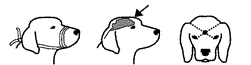
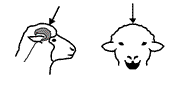
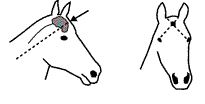
(Images from ICWDM.org)
Keep in mind that even a well-placed shot may result in violent convulsions of your pet. Remember, your pet is now unconscious, feeling nothing. This is still a humane death, and in reality, much more compassionate that taking him down to the vet to die in a sterile environment far from home.
References:
https://icwdm.org/management/shooting/shooting-as-euthanasia/
https://www.outdoorlife.com/blogs/gun-dogs/2009/11/how-kill-your-dog/
https://vetmeds.org/pet-poison-control-list/acetaminophen/#!form/PPCDonations https://keepingdog.com/your-how-much-benadryl-is-fatal-for-a-dog/ http://www.alysion.org/euthanasia/


Sorry for the loss of your friend. As a note (I am not a Vet), using carbon dioxide wouldn't be a good choice. Since we're all air-breathers, our bodies are very keen when the CO2 level gets too high
ReplyDelete(hypercapnic alarm response) and will react accordingly. A better method might be using nitrogen gas, since we don't have anything in our physiological system to detect it.
Sorry for your loss. Dogs really are our best friends. It may seem harsh, but your diagrams for shot placement are sound.
ReplyDeleteSorry about your dog.
ReplyDeleteExile1981