Thursday, January 31, 2019

Food Storage Calculator--The Best Ever

As the title suggests, this is, hands-down, the best food storage calculator I have ever seen anywhere.  If anyone has a link to a better, or even just a different but good one, please post it in the comments section below.

Before you go over to check it out, or worse, totally ignore the information, let me tell you what's so great about it.

  • People.  It lets you plug in the number of people you are preparing for. 
  • Months.  You then enter the number of months.  Most food storage calculators include these two.
  • Lifestyle.  This is where it begins to shine.  Do you want to store enough food to be "hungry but alive," "satisfied," or "living comfortably"?
  • The food.  Not only does it cover the basics--grains, legumes, sugars, oils, milk, and salt--but it also includes fruits, vegetables, baking essentials, and water, and it has several sections for each category with recommended amounts of each item.  
All you do is enter your little bit of info and it shoots back the recommended amounts faster than you can blink. Of course, you may not be interested in some of the food category suggestions.  I don't store powdered fruit drink, but I do store hot chocolate.  I don't store mayonnaise, but I do store extra oil for making my own mayonnaise.  You get the idea.  You can make your substitutions and make it work.

Food Storage Calculator

The site that hosts this food storage calculator is run by the Highland Stake of the Church of Jesus Christ of Latter-day Saints. And everything they have on their site pertaining to food storage and preparing for emergencies is fabulous.  I mean, really, really good.

If they could come up with an app that would calculate all the food we have everywhere in the house (and elsewhere), my life would be complete.

Monday, January 21, 2019

The Medicinal Uses of Red Raspberry Leaf

Disclaimer.  I am not a licensed health practitioner.  This is just another post on an item you might wish to have available if needed so that a physician can treat you and your family as best as possible.  No medication, including those available over the counter, should be taken without consulting a physician.  Information shared here is for educational and entertainment purposes only.  It is not medical advice nor a substitute for licensed medical care.  A qualified, licensed physician or other medical provider should be consulted before beginning any herbal or conventional treatment.


When my family and I talk about the five years that we lived in Missouri, we usually mention the only three good things about our time there, the three F's:  friends (a few great friends), fireflies (who doesn't love them?), and fireworks (the most phenomenal displays I ever saw were put on by a lawyer friend from church--nothing at Disneyland, or at city/county Fourth of July events, or even Michael Milken's personal event at Lake Tahoe--no, we weren't his guests, just on a neighboring section of the beach--could come close to this lawyer's show).  But as I begin this post on raspberries, I remember how prolific the raspberries in my garden there were.  I spent a couple of hours three times each week during harvest season to pick them.  Wow, I miss those raspberries.

And as delicious and desirable as those raspberries were, the true treasure was in the leaves.  Little did I know then.  Raspberry leaves are loaded with vitamins A, B1, B2, B3, C, and E, as well as the essential minerals iron (one ounce of raspberry leaves yields 18% of the RDA for iron), magnesium, potassium, zinc, and calcium.  For this reason alone you are really going to want these gems growing on your property in addition to being able to find them elsewhere.

Time to harvest:  Raspberry leaves should be harvested in the summer, rinsed, and dried well in a dehydrator or in the shade.  Insufficiently dried leaves can become toxic.

Fortunately, raspberry leaves are very easy to use.  Their active constituents are, in contrast to many other herbal remedies, extracted with water.  No alcohol involved.

Infusion:  One to two teaspoons of dried leaves per cup of boiling water.  Let steep for fifteen minutes. Drink three to four cups per day for treating diarrhea, incontinence, PMS symptoms, leg cramps, gout, and arthritis. It is particularly useful for easing painful menstrual cramps and regulating menstrual flow, especially when taken regularly.  Historically, raspberry leaf tea was used to ease labor pains, improve the quality of contractions, and help build a good supply of breast milk.  Though some sources suggest it can be used for treating morning sickness and nausea, it should be used with caution and only under the direction of a licensed medical practitioner during the first and second trimester of pregnancy. 

Decoction:  Steep five tablespoons of raspberry leaves in one quart of water for fifteen minutes.  Use as a rinse or gargle to treat tonsillitis, canker sores, cold sores, gingivitis, and sore throat.  This same decoction can be used for treating eczema, acne, dermatitis, and itching of the skin.  The cooled and filtered decoction is used to treat conjunctivitis of the eyes.

Poultice:  Dip a clean cloth into the decoction above and apply to minor wounds, varicose veins, and minor burns like a sunburn.

Contraindications:  Raspberry leaf is not for internal use in people with gastritis or peptic ulcer, or those with uterine fibroids, uterine cancer, ovarian cancer, or endometriosis. 

For further information:
https://onlinelibrary.wiley.com/doi/full/10.1016/S1526-9523%2801%2900095-2
https://www.drugs.com/npp/raspberry.html#fandc-np5263.b2
https://www.healthline.com/nutrition/red-raspberry-leaf-tea#bottom-line
https://theherbalacademy.com/3-raspberry-leaf-benefits-for-women/


© 2019, PrepSchoolDaily.blogspot.com

12 september 2022

27 september 2020
 

Saturday, January 19, 2019

Expanded Food Storage--Pressure Canning Pork

In my family the first Saturday in December is Tamale Day.  My mom and aunts began this tradition over thirty years ago as a way of celebrating our Mexican heritage and keeping connected with the family.  We continue the tradition, but because my family is some distance away from the others and because my family is rather large by today's standards, we celebrate and make tamales on our own.  And we do it in a prepping kind of way.

Everyone else in the world slow roasts and shreds the pork for filling tamales the day before.  I do it the year before, but without roasting.  I can the pork.  It makes getting ready for Tamale Day so much less stressful.  The pork is perfectly cooked and shreds so easily.  Of course, canned pork is not just for tamales.  We also use it for making super speedy pulled pork sandwiches, quesadillas, and tacos.  It's a major convenience.

And it's so easy.

Cut up the raw pork into one-inch cubes.  Try to remove as much fat as possible to reduce chances of seal failure.  Pack into canning jars.  I use quart jars for the pork that will be used to make tamales, about one quart per dozen tamales, and we usually make twelve to fifteen dozen tamales and then freeze them.  I use pint jars for pulled pork sandwiches, quesadillas, and tacos.

Fill jars to one inch below the rim and add salt--one teaspoon per quart, one-half teaspoon per pint.  Do not add any liquid.  Liquid is never added when canning raw meats.  The meat produces its own juice.  Wipe rims very carefully with vinegar.  Most say to just use hot water, but when dealing with foods that may have fat on them, vinegar will cut that fat and make for a better seal.  Put on lids and bands and process per instructions for your particular canner and your altitude and jar size.  Typically pints are processed for 75 minutes and quarts for 90 minutes.

That's all there is to it.

When you open a jar for making tamales, drain off and reserve the liquid.  It is used in making the masa.  For all other recipes, you can save the broth for using in soup, or you can do what we do and pour it over the dogs' food.

If we're making pulled pork sandwiches, we just heat the meat with some barbecue sauce.  For tacos, add your own seasonings to taste.

When times get really interesting, and when cooking fuel becomes expensive either in terms of money or of time spent gathering, and time for preparing food becomes even more scarce than it already is, being able to preserve foods and having those foods ready to eat will be really invaluable. 

And even more invaluable will be having learned how to do this before the crisis hits.

Thursday, January 10, 2019

Compressed Toilet Paper and Washcloths

I'm always on the lookout for items that will make my life easier post-collapse or in a disaster.  And sometime in the past couple of months I came across compressed washcloths.

I was intrigued.  They were tiny.  And when they arrived, they were indeed about the size of a Life Saver.  In my backpack I usually carried a pack of baby wipes, but even the smallest packages can take up a bit of space.  Especially when I didn't use them all that often.  And then they start to looking kinda cruddy after a while, and you're embarrassed to be seen carrying or using them. 

Paper Hand Towel Roll Reviews - Online Shopping Paper Hand ...
I got mine from Survival General, but I couldn't copy their image here.  But this is pretty much what mine (and all the others sold online) look like.
Enter the compressed washcloth.  They're so small, you can put them anywhere.  And they're so cheap that you can buy a lot so that you can put them anywhere and everywhere.  So they have gone into all the emergency packs and camp kits.  These compressed washcloths are about the size of a regular baby wipe, and I would guess they would be about as durable.  They take about 10 seconds to re-hydrate and then it takes about a minute to unfold, maybe less. 

A month or so later on Amazon, I happened upon something very similar, marketed and sold by Hi-Qual as compressed toilet paper.  Of course, I had to have some.  After all, it might be better than using a compressed washcloth.

Nope.  Exactly the same materials (which I could have read online before purchase).  Same size.  However, and this could be critical, it took only two to three seconds to re-hydrate.  Same minute or less to unfold.
 
There are a lot of companies on Amazon selling these washcloths/toilet paper/camping towels, whatever you want to call them, ranging from about eight dollars per hundred up to ridiculous prices.  I prefer getting the ones that are individually packaged so that I can put just one or two in a backpack and they'll remain clean until needed.

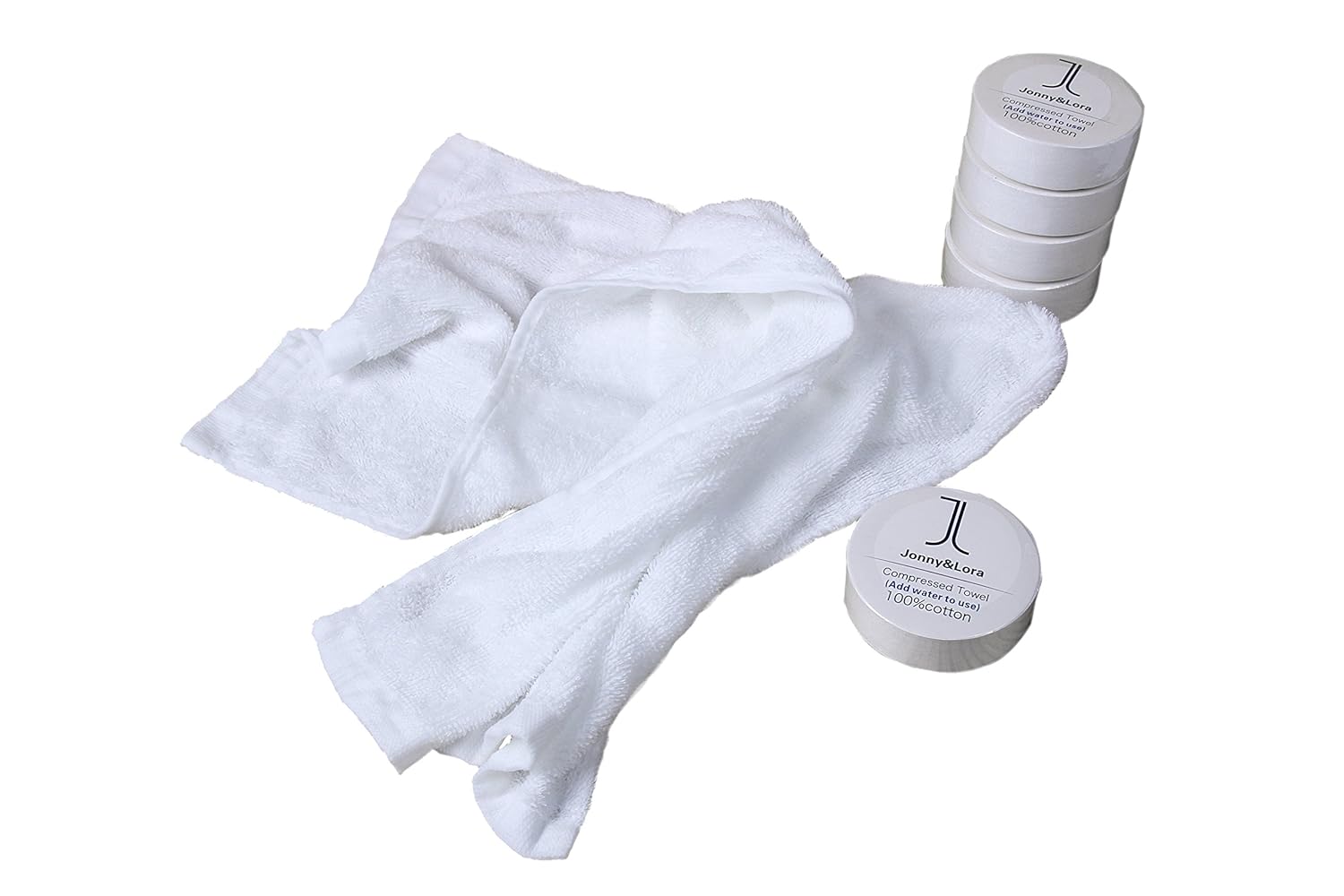
The next item is an actual real washcloth like you use in your bathroom every day.  These are 12"x12" 100% cotton washcloths that can be machine washed and dried and used again and again.  And they also come in a larger compressed brick that is a 12"x27" hand towel if that suits your needs better.  
Jonny & Lora compressed towels.  Somehow I think that towel laid out above is not the washcloth advertised.

Of course, these are real towels, so they cost more, about a dollar each.  I'm not sure that they are that much more desirable to have in an emergency than the smaller, cheaper washcloths at the expense of space for other necessary items.  But I throw them in the bags for now.

© 2019, PrepSchoolDaily.blogspot.com 

12 january 2023