Tuesday, December 31, 2019

How To Make Injectable Lidocaine

Disclaimer.  I am not a licensed health practitioner.  This is just another post on knowledge and understanding you might wish to acquire in advance of a disaster in case no higher care is available.  As long as our society is functioning, you should leave anything more substantial than applying a Band-Aid to the professionals.  No medication, including those available over the counter, should be taken without consulting a physician.  Information shared here is for educational and entertainment purposes only.  It is not medical advice nor a substitute for licensed medical care. 

 
Just to reiterate the disclaimer, this is a post on supplies and knowledge you want to have before you need it.  Everything about making injectable lidocaine should only be done by a licensed physician or pharmacist or under their direction and supervision.

The instructions for making injectable lidocaine when our society has totally collapsed and there is no higher medical care available were first posted online in 2013.  A few years later a physician reviewed those instructions and added his own comments.  (Addresses for those articles are provided below.  I provide addresses rather than links because sometimes a link will disappear, but with an address it may still be possible to track down the desired article.  I've had that happen quite a few times.)

Making injectable lidocaine is not at all complicated, but it is important to be careful and very precise.  It is easy to overdose a patient with lidocaine.  You want to avoid that.

Let's assume you already have scissors, a surgical clamp of some sort, and a candy thermometer or similar, as well as the lidocaine HCL, as was covered in an earlier post.  Here are the additional supplies you'll need:

  • Sterile saline.  Preferably labeled as being for injection.  But that can be hard to come by for unlicensed individuals.  A grid-down, out in the wilderness hours or days away from a hospital solution is the single-use vials of sterile saline mentioned last week.  
  • Scale that can accurately measure milligrams.  Digital scales start at about $20.  Non-electronic scales start around $30.  I have no experience with either yet.  A lot of reviewers on Amazon indicate that they use both scales for reloading ammunition.  If you have someone like that in your family, and they have a scale, I would love to have confirmation that their scale (with brand and model information) will accurately measure minute quantities of powder.
  • A very small funnel to transfer the lidocaine HCL into the bottle of sterile saline.   
Before beginning, make sure all the instruments are sterilized--clamp, scissors, funnel.  Disinfect the scale thoroughly, especially the pan that will hold the lidocaine.  Wash and scrub your hands thoroughly and put on gloves.

To make a 1% lidocaine HCL solution:
  1. Weigh 150 mg of lidocaine HCL on the scale.  
  2. Cut off the top of a 15 ml sterile saline vial about halfway down the neck.
  3. Insert the funnel securely into the neck of the vial.  
  4. Pour the lidocaine into the funnel.  (If the powder sticks to the funnel, squeeze the vial gently to move some saline into the funnel.  Then release so that the saline drains back into the vial, taking the lidocaine with it.  You may have to repeat this procedure a few times to get all the lidocaine into the vial.) 
  5. Remove the funnel.
  6. Close the neck of the vial using your surgical clamp. 
To make a 2% lidocaine HCL solution:
  1. Weigh 300 mg of lidocaine HCL on the scale.
  2. Follow steps 2-6 above.
For both 1% and 2% lidocaine solutions:
  1. Create a double boiler with a small canning jar almost filled with water placed in a pan of water over the stove.  You just need clean tap water; it doesn't need to be sterile or distilled.
  2. Place the vial in the canning jar, but be especially careful not to submerge it near the openings.  Do not let any tap water enter the vial, which would contaminate the solution.
  3. Heat the water past 176 degrees Fahrenheit.  (Lidocaine dissolves in water, but it doesn't melt until it reaches 176 degrees F.  Melting ensures even distribution.) 
  4. Remove the vial from the jar.  Do not remove the clamp.
  5. Let cool.
  6. You now have a 1 or 2% solution of lidocaine HCL.
  7. This solution should be used within 24 hours and discarded thereafter.

To use this solution, with the clamp still in place, clean the top of the vial with an alcohol pad.  Invert the vial, insert the needle through the top of the vial, and draw out the desired amount of lidocaine into the syringe. 

Links to related posts:
Lidocaine
Little Vials of Sterile Saline
Benadryl
Rubbing Alcohol 

For further reading
https://modernsurvivalonline.com/guest-post-how-to-make-injectable-lidocaine-hcl/
https://griddownmed.blog/2015/04/25/from-modern-survival-online-make-your-own-lidocaine-topical-anesthetic/
https://dailymed.nlm.nih.gov/dailymed/fda/fdaDrugXsl.cfm?setid=C7A7D3D2-7638-4570-9EB8-A5E2BEC82B5D
https://www.ncbi.nlm.nih.gov/pmc/articles/PMC3433813/
https://www.fda.gov/inspections-compliance-enforcement-and-criminal-investigations/inspection-technical-guides/pyrogens-still-danger

© 2019, PrepSchoolDaily.blogspot.com

4.26.23

Wednesday, December 25, 2019

Merry Christmas! And My Gift to You Is... Brownies!!

May we all remember the glorious gift of our Heavenly Father as we celebrate the birth of His Beloved Son.  May we all strive to be a little better, a little kinder in the coming year, and reflect a little of the Savior's light to those around us.  And, God willing, may we all find ourselves still here and happy with our families next Christmas.
Now go back to your family and spend a beautiful day with them.  The goodies will still be here tomorrow.


So my gift to you wonderful readers this year is a lifetime supply of brownies!  Store all the ingredients you need, and it's the gift that will keep on giving through the end of the apocalypse!

The three recipe options below are for a small batch of brownies baked in a bread loaf pan.  Make a small batch of brownies when you need a little fix.  It will help make your supplies of these ingredients last longer.  The traditional recipe utilizes regular grid-up and happy days fresh ingredients.  Both just-add-water mixes use powdered eggs and powdered vanilla extract.  You can find the latter in upper-end grocery stores right by the vanilla extract and on Amazon.    Just-add-water mix #1 has straight coconut oil; mix #2 replaces some of the coconut oil with butter powder and water and thus the brownies are a little less oily.

Both mixes can be prepared in advance; add the water later when you're ready to bake.  However, before you make multiple mixes, make one batch to try out first.  These recipes produce fudgy brownies, not cake-like brownies.  And these are not overly sweet brownies.  Queen of the Picky Eaters and her sister and father want more sugar.  The rest of us like the semi-sweet or dark chocolate flavor of this brownie. 


Traditional recipe
Just-add-water mix #1
Just-add-water mix #2
¼ cup butter
¼ cup coconut oil
2 tablespoons coconut oil


3 tablespoons butter powder
½ cup + 1 tablespoon sugar
¼ cup + 2 tablespoons cocoa powder
¼ teaspoon salt
¼ teaspoon salt
¼ teaspoon salt
1 egg
2 tablespoons egg powder
¼ cup flour
¼ cup flour
¼ cup flour
½ teaspoon vanilla extract
½ teaspoon vanilla powder

¼ cup water
1/3 cup water

Preheat oven to 325 degrees.  Line a bread loaf pan with parchment paper.

Mix all ingredients together in a medium bowl just until combined.  


Spoon the batter into the prepared bread pan.  Bake for 23 minutes.  Let cool 5 minutes in the pan and then use the parchment paper to remove the brownies from the pan.  Let cool on a cooling rack. 


Peanut Butter Swirl Brownies
Follow the exact directions for the brownies above. 

Then combine the following:
2 tablespoons creamy peanut butter
1 tablespoon powdered sugar

Drizzle, swirl, dot, whatever, the peanut butter mixture over the top of the brownie batter.  Bake the same as for the chocolate brownies above.

Merry Christmas!

Links to related posts:
Coconut Oil
Cocoa

Preparedness  survival  emergency  bugging out in bug pack survivalist prepper freeze dried dehydrated food storage gamma lid bucket #10 can medicine supplies supply emergencies disaster natural civil war political unrest hyperinflation inflation canning jar Mylar oxygen absorber disease
© 2019, PrepSchoolDaily.blogspot.com
injury pneumothorax family children antibiotics alternative refrigeration solar communications salmonella pneumonia CPR medic mask gloves beans wheat rice oats corn oil coconut water purification filtration iodine pasta sugar salt iodized dry powdered milk mountain house essentials bread education home school vitamins skills chickens goats rabbits homestead redoubt American fuel wood ticks mosquitoes repellent disinfect sterilize Armageddon TEOTWAWKI SHTF WTSHT

Saturday, December 21, 2019

Homemade Fritos

Comfort food goes a long way in a crisis.  Difficulties are just so much more manageable when you've got good food to sustain morale.  And for one of my daughters, QOTPE, that food is Fritos.

Being a good mom (at least, some days) and having been known to enjoy more than a few corn chips myself, I decided to see if there was a way to make them at home.  There are exactly three recipes online as of this writing (addresses below).  I tried two of the three.  The third one was so far off the Fritos ingredients (real Fritos do not have cayenne pepper or flax seed oil or safflower oil) that I didn't bother. 

No matter what I did--rolling thinner, salting more, sprinkling fairy dust, or just hoping really, really hard, they were nothing like real Fritos.  Now, I wouldn't call them an epic fail, because in this case, I believe an epic fail would call for barfing.  There was definitely no vomiting involved.  But there was nothing anyone would want to keep eating, either.  Sorry, QOTPE.

I have a couple of suspicions as to why DIY Fritos just don't work.

The first is that Frito-Lay company has industrial equipment for mechanically processing the grain and the chips.  We can't duplicate that at home.  Even with the edges of the chips that were rolled out so very thinly, the texture and taste just weren't there.

The second is that I also suspect that Frito-Lay has a certain variety of corn that they use for their chips.  The dent corn I have here, and which I suspect most people would be using, just doesn't have that true corn chip essence to it.  What I made here was far closer to regular tortilla chips, which would also be more easily made just by making corn tortillas and then frying those.

Just in case you want to confirm for yourself how right I am, here are the addresses for the recipes I tried, and the one I passed on:

https://www.justapinch.com/recipes/snack/chip-snack/homemade-fritos.html
https://eatup.kitchen/homemade-fritos/
https://www.splendidtable.org/recipes/corn-chip-strips

Links to other recipes that just don't work:
Rice Krispiesd educat

Wednesday, December 18, 2019

Foreign Body in Nose

It is the dreaded FBIN.  Foreign body in nose.  Your otherwise adorable, brilliant toddler decided TEOTWAWKI would be a great time to see if shoving peas up her nose would keep her from having to eat them. 

This is not good.  And because you are not a physician with the cool tools of the emergency department, the options for removing the FBIN are limited.  However, if you start to panic, your child is going to stress out as well, and that will make everything worse.  Just to add more pressure, statistics show that your child is only going to allow one or two attempts at most for clearing her nose.  This has to be done right the first time.

The very first thing to do, as soon as you know you've got a problem, is to get the child to breathe through her mouth.  Sniffling may move the object farther up the nasal passage.   Depending on exactly what is up her nose and how painful it is, pain medication may be required to help calm her down.  In a situation like this, many doctors turn to an anti-inflammatory like ibuprofen and in some cases would consider a sedative as well. 

Most of the time, you are going to know what is up her nose.  She was playing with beads, or Legos, candy, batteries, magnets, or pencil erasers.  Beans, seeds, bugs.  Maybe pebbles.  How you approach removing the FBIN is going to depend largely on what exactly it is.  Is it hard?  Soft?  Round?  Square?  Smaller?  Larger?  Smooth?  Rough?  Metallic?

A physician has several options in a grid-down situation where there is no ER:

  • Positive pressure (child).  The child pinches the clear side of the nose closed, takes a deep breath, and exhales forcibly through the side with the foreign body.  This method is good for solid objects like beans and beads.  It is difficult for small children to perform.
  • Positive pressure (parent, kissing technique, mouth-to-mouth).  While pinching the clear side of the nose closed, a parent performs mouth-to-mouth, forcefully blowing air through the child's mouth in an effort to dislodge the object.  
  • Positive pressure (straw).  It's the same as the positive pressure parent technique above, but using a straw between the two mouths instead.  Quick puffs are delivered through the straw.
  • Bulb syringe.  This is also primarily for removing round, smooth objects.  Make sure you have a good seal with the nostril and suck the foreign body out.  The syringe may need to be trimmed to work.  Do not risk pushing the object farther up the nasal passageway with a bulb syringe that is too long. 
  • Derma-Bond, Vet-Bond (do not use super glue!).  Put a little of this glue on a small stick, like a Q-tip with the cotton removed.  Make contact with the foreign body and hold in place for at least 60 seconds before attempting to remove.
  • Saline washout.  Fill a bulb syringe with 7 ml of sterile saline.  Insert the bulb syringe in the opposite nostril and advance it until you form a tight seal between the nostril and the bulb syringe.  Squeeze the bulb forcibly to eject the saline to the other side.  The saline will hopefully carry the object out the other nostril.  This method is good for friable objects like crackers.  
  • Tweezers.  May work for some objects.  Don't risk pushing the object further up the nasal passage.
  • A bent paper clip or a wire loop held by a hemostat.  Either of these can be used to rotate around the inside of the nostril between the object and the mucous membrane to dislodge and remove the foreign object. 


Sometimes children do things that escape our notice, and some of the foreign bodies children choose to shove up their noses don't cause immediate discomfort, or even any discomfort.  Peas and raisins are nice and soft and squishy.  Something like that is going to eventually start giving off a very foul odor.  And there will be a runny nose, but only on one side.  (Unless, of course, the objects were shoved up both nostrils.  A parent's natural reaction is to panic, thinking there's some type of infection.  However, there will be no fever.  Careful questioning may reveal that the child did indeed shove something up her nose. 

Other items you are going to want for this situation include a very good headlamp with a strong light to it and a small pair of pliers to hold the nostril open (unless, of course, you have a nasal speculum on hand).

Links to related posts:
Glues
Saline solution

For further reading
https://www.oatext.com/20-ways-of-removing-a-nasal-foreign-body-in-the-emergency-department.php
https://www.webmd.com/first-aid/foreign-body-nose-treatment
https://www.drugs.com/cg/nasal-foreign-body-in-children.html
https://www.healthline.com/health/foreign-body-in-the-nose#treatment

© 2019, PrepSchoolDaily.blogspot.com  

4.16.23

Friday, November 29, 2019

Homemade Corn Flakes

About ten years ago, Honeyville Grain had a sale on dent corn. (Dent corn is not sweet corn, like the vegetable side dish. It is the hard, dry grain that cornmeal comes from.) I bought one hundred pounds of it. I guess I was planning on a lot of cornbread. I'm not quite sure right now.

Anyway, we just don't eat that much cornbread. Maybe if we start having more chili.

So while surfing online a few months back and looking for breakfast cereal recipes, I came across this one for homemade corn flakes. Ah, a way to use some of that dent corn!

I watched this Youtube and found the guy a bit entertaining. But because he's British, everything was in metric measurements. So I made the conversions and here is the modified recipe:

Homemade Corn Flakes
1 1/4 cups cornmeal
1 1/2 cups cold water
1 tablespoon sugar
1 teaspoon vanilla extract

Combine everything and mix until smooth. You may need to add a bit more water. You want a thin pancake batter consistency. Pour the batter onto four cookie sheets lined with parchment paper. (Do not try to substitute waxed paper or foil. I already did, and it doesn't work at all.) The batter needs to be in a very thin layer on the cookie sheets to bake up nice and crispy. Bake at 350 degrees for 10 minutes and then remove from oven and allow to cool a bit. Then bake again at 250 degrees for 20 minutes. 

If you're really lucky, you get good corn flakes.

But there's the reality of having to get the consistency of the batter perfect, bake it perfectly, and being able to remove it perfectly from the sheet. I consistently had flakes that were too thick, so they weren't crunchy, or so thin that they shattered. To be fair, I also had some that were respectable in size. This batch will make enough for maybe four bowls of cereal. It will take at least an hour of baking if you are really efficient. It may not be a big deal when you have easy electricity, but if you're using any kind of alternative, it may be cost-prohibitive. Of course, you could use a solar oven, but then you also have to have the pan perfectly level. And if your sun oven is small, it's going to require a full day of baking. 

As far as the flakes that were the right size, the flavor was pretty spot on. Unfortunately, the texture just is not. Store-bought corn flakes are light and thin and crispy. And you just can't get that thin crispiness--and maintain the right size--doing it by hand. It would be a lot more difficult in challenging conditions.

Just so you know what I'm basing this comparison on, I made the DIY stuff and tasted it fresh out of the oven after it had cooled down. It was then compared with a jar of corn flakes I came across a few months ago, and which was vacuum-sealed in a canning jar in 2009. Yep, ten years ago. I added a little bit of milk and sugar to each.

The ten-year-old stuff is the hands-down winner again.

So yeah, you can DIY the corn flakes and spend a lot of time and get a sub-par product that will be okay. Or you can save yourself a lot of time and effort and just vacuum seal some. Oh, and I didn't even use an oxygen absorber.

Links to related posts:   

For further information:
https://www.youtube.com/watch?v=8BZivlZoHdo

© 2019, PrepSchoolDaily.blogspot.com

Monday, October 21, 2019

Coconut Oil--Health Uses

If I could store only one kind of oil in my food storage, coconut oil would definitely be it.  It's like a prepper's dream.  Add in the medicinal uses, and coconut oil becomes a prepper's fantasy come true.  Factor in some of the health uses, and that just seals the deal.  You really can't have too much coconut oil.  Those readers into cosmetics and beauty and such would do well to research the beauty uses of coconut oil.  There's zillions of articles on them on the 'net.


The first best health use of coconut oil is for toothpaste.  Mix 1 tablespoon baking soda and 1 tablespoon coconut oil, and add in two drops of peppermint essential oil.  Yes, it lacks fluoride.  But some people are a little skeptical about using fluoride.  Those who want fluoride in their toothpaste are going to have to buy it that way.  Coconut oil has antibacterial properties to it, so it's a win in my book.

Gingivitis can be reduced or eliminated with daily coconut oil pulling, which is basically swishing coconut oil around in the mouth for two to three minutes each day.  Most people do it in the shower and then spit it down the drain.

After the shower, use coconut oil as a body and facial moisturizer.  It's cheap and it helps rotate your oil supply well.  Healthy skin is far less susceptible to infection. 

Coconut oil is a weak sunscreen, with an SPF of about 4.

Use coconut oil for a great leave-in conditioner.  Apply about 1/2 teaspoon just after showering and work it into the hair. 

For a fantastic, natural, and inexpensive lip balm, combine 3 tablespoons coconut oil with 2 tablespoons beeswax in a double boiler.  When melted, stir to combine well and then pour into tin lip balm tins or empty lip balm sticks (you can get them on Amazon).  You can tint your lip balm with bits of old lipstick or a small amount of berry Kool-Aid.  (Yeah, the cosmetic uses aren't a big thing with me or my girls, really.  I wear light make-up when I go out, kinda of as a public service more than anything.  Becky, who's in college, wears light make-up once or twice a week; the 15- and 18-year olds--never.  It's just not our thing.  But for some women and girls, a little make-up will go a long ways in maintaining a little bit of normalcy and mental health boost for them.)

Links to related posts:
Basic Food Storage--Coconut Oil
Alternative Medicine--Coconut Oil
Emergency Baby Formulas 

For further reading:
https://www.ncbi.nlm.nih.gov/pubmed/22279374 (sunscreen)
http://www.ijdr.in/article.asp?issn=0970-9290;year=2009;volume=20;issue=1;spage=47;epage=51;aulast=Asokan (oil pulling to reduce gingivitis)
https://www.health.com/sexual-health/coconut-oil-lube (lubricant)
https://fabulousfarmgirl.com/essential-oils/coconut-oil-uses/

© 2019, PrepSchoolDaily.blogspot.com 

9 march 2023

Saturday, October 12, 2019

Layered Chili

As I compose this post, it is the end of September.  I am sitting on my bed, looking out the window at all this white stuff falling from the sky.  From November through April we call it snow.  But at the end of September, when I am still supposed to have at least five weeks of gardening, it is called something else.

I guess that's why we harvested the rest of the beans, squash, and corn this morning.  I picked all beefsteak-type tomatoes off the three pretty sorry-looking plants, about ten gallons in all.  I have tarps and sheets outside and ready to cover the tomatoes after the worst of the wind passes, but I'm not entirely sure they'll do any good.  Gotta love global warming.

Anyway, because I knew it was going to be cold today and that I would not be doing any outside work, I soaked several pounds of pinto beans last night to can today.  We're down to the last jar or so, and running out of canned pinto beans is a major crisis around here.

Major crisis aside, I think I soaked too many.  So it was time to pull out the layered chili recipe.  And happily, it's less labor-intensive than I remembered.  It's by no means the family's favorite chili--that would be White Chicken Chili--but we really favor this for making taco salad.  And it also works for those busy days when life does not go according to schedule.

Layered Chili
2 1/2 cups beans, soaked overnight and cooked for 30 minutes before canning
1/4 cup chopped onions
2 tablespoons tomato sauce
2 tablespoons chili powder
1 teaspoon canning salt
1/4 teaspoon cumin
dash pepper

Layer the ingredients in quart canning jars.  Fill within one inch of the top with boiling water.  Process in a pressure canner for 90 minutes and 15 pounds pressure.

Links to related posts:
Home Canned Tomato Sauce
Pressure Canning Dry Beans

© 2019, PrepSchoolDaily.blogspot.com

Saturday, September 28, 2019

Canning Your Own Chicken Stock

Most commercial chicken stock on the market now is sold in those aseptic boxes rather than cans.  As such, commercial chicken stock doesn't have a great shelf life--two years in the best of cases.  However, there is the advantage of possibly being the better choice in earthquake country since there is no glass to break.
If you want to make your own however, because you don't live in earthquake country, or you think being able to control what exactly goes into your stock is important, here's a recipe for you. It's really pretty quick and simple, yet so nice to have to get meals together quickly. 

Homemade Chicken Stock
about 3.5 lbs raw chicken, cut into pieces
16 cups water
2 stalks celery
1 carrot
2 medium onions, quartered
1 tablespoon salt, optional*
8 peppercorns
2 bay leaves


Directions
In a large stock pot, bring all ingredients to a boil.  Reduce heat and simmer 2-3 hours, or until chicken is tender.  Remove from heat.

Remove all the solids by straining through a sieve or cheesecloth.  Set the meat and bones aside for another use.  Put the stock in the refrigerator until the fat solidifies, about two hours, and remove it.

To prepare for canning, heat the chicken stock to a boil.  And in the meantime prepare your pressure canner, jars, and lids as usual.

Pour the boiling chicken stock into hot jars, leaving one inch of headspace, apply lids and bands, and process:  20 minutes for pints, 25 minutes for quarts, at 10 pounds pressure and adjusting for your altitude per your pressure canner's directions.

Yield:  8 pints.

*In this recipe, as in most canning recipes, the salt is optional.  In canning, salt is not a preservative and it is not going to affect the pH.  It is for flavor only.  If you or someone you are preparing this food for is on a low-sodium diet, you can omit the salt and let individuals salt their food at mealtime.

As for the chicken you used to make the stock, you can use it to make dinner.  Casseroles, chicken salad sandwiches, and Hawaiian haystacks are good choices.  You can also dehydrate it to turn it into chicken bouillon.  

Don't throw away the chicken fat!  Like bacon fat, it can be used to saute vegetables and season savory dishes.   If nothing else, drizzle it over pet food.

If you don't have a cat, just toss the bones.  However, if you do have a cat, pressure canned chicken bones work well as an emergency cat food that we have resorted to several times when our daughters failed to tell us that we needed to re-stock the cat kibble.  Directions for this are at the link below.


Links to related posts:
DIY Chicken bouillon
Pressure canning chicken (and bones for the cats)

For further reading:
https://www.freshpreserving.com/chicken-stock---pressure-canning---ball-recipes-br1070.html
https://food-hacks.wonderhowto.com/how-to/why-you-should-never-throw-away-chicken-fat-0160956/
https://www.thehealthyhomeeconomist.com/caution-when-using-chicken-fat-for-cooking/
https://www.thekitchn.com/good-question-what-to-do-with-1-66534

© 2019, PrepSchoolDaily.blogspot.com

Friday, September 27, 2019

The Importance of Being Able To Alter Recipes

Another skill that will become important down the road is the ability to alter recipes.  Right now, I plan for leftovers.  I love leftovers, whether it's being able to have an easy lunch the next day, or making a double batch of lasagna for dinner so that one can be frozen for use later in the month.  But as the reality hit me a few years back, I realized the electricity may not be around forever, or it may not be reliable enough for safe food refrigeration.  I would need to be able to prepare just enough food for the upcoming meal so that leftovers wouldn't spoil and waste precious food.  I'm really going to miss that someday.

That means I'm going to have to be able to alter most of my family's favorite recipes.  It's something we all go through to some extent as children grow and then strike out on their own. When the children were younger and our family was growing, it was easy to simply double a recipe to feed everyone.  But scaling down has different challenges.  How to you go from one egg to one half?  Or what if you have to reduce a recipe to make one or two loaves instead of three?  That's a bit more math than is sometimes easily done in the head.  Well, it was easier when I was younger.

Even if all the ingredients are bulk, reducing the amounts called for can be a challenge.  But when you need to go from one full can to one-half or one-third of a can, that can mean some serious waste.  However, if the canned goods can be replaced with dehydrated or freeze-dried ingredients, the waste is eliminated.

For example:

Instead of doing what I should have been doing one day, I was surfing the web and somehow stumbled upon a recipe for Southwestern Wheat Bread.  I tweaked it a little bit, and it turned out great.  The family all enjoyed the change of pace.  The original-but-adapted-a-little-bit recipe is below.

Southwestern Wheat Bread
1 3/4 cups warm water
1 tablespoon yeast
1/2 cup cornmeal
4 cups whole wheat flour
4 cups white flour
2 tablespoons oil1 tablespoon salt
1 can (4 oz) diced green chilies
1 can (4 oz) chopped olives, drained
1 can (15 oz) corn, drained
1 large onion, chopped
1-2 jalapenos, seeded and chopped
3 cloves garlic, chopped
1 cup shredded cheddar cheese, optional


Dissolve yeast in warm water.  Stir in remaining ingredients and knead ten minutes, adding more flour if necessary.  Let rise one hour in a warm location.  Punch down dough, divide into three pieces, and form three loaves.  Place in greased 4x8" loaf pans and let rise again.  Bake at 375 for 35-40 minutes, or until done.

Comments:  The only thing I didn't really like is that it makes three loaves.  It's fine when life is all hunky-dorry and the bread can be frozen for later.  We all really like fresh homemade bread around here, and we like a change of pace, but three loaves of most anything but sandwich bread is a little much to go through.  Unfortunately, when refrigeration is limited down the road, opening cans of green chilies, olives, and corn to use only a third of each to make one loaf of bread isn't going to work well, either.

But there is a workaround, and that is dehydrating the vegetables.  Now I already buy dehydrated onions.  They're easy enough to do at home, but the smell is pretty potent and it's so cheap to buy them at the Home Storage Center.  So that leaves the chilies, jalapenos, olives, and corn.  Frozen corn is super easy to dehydrate.  Buy frozen corn, dump on dehydrator tray, return in 8-12 hours, cool, and package for longer term storage.  With olives, just open the can, drain well, spread them on the dehydrator tray, and check them after 5-6 hours.  Green chilies and jalapenos can be done the same way, or you can pick them fresh from the garden and then dehydrate them.  And this way, it's so much easier to measure out just what is needed for making one loaf of bread.

Southwestern Wheat Bread using dehydrated vegetables

3/4 cup warm water
1 teaspoon yeast
1/4 teaspoon sugar
3 tablespoons cornmeal
1 1/3 cups whole wheat flour
1 1/3 cups white flour
2 teaspoons oil1 teaspoon salt
1 tablespoon dehydrated diced green chilies
1 tablespoon dehydrated chopped olives
3 tablespoons dehydrated corn
2 tablespoons dehydrated onions
1 teaspoon dehydrated chopped jalapenos
1 clove garlic, chopped
1/3 cup shredded cheddar cheese, optional

Rehydrate the dehydrated vegetables in warm water for 30-45 minutes before beginning to make the bread.  After the vegetables have rehydrated, add the yeast and sugar.  Stir in remaining ingredients and knead ten minutes, adding more flour if necessary.  Let rise one hour in a warm location.  Punch down dough and form into a loaf.  Place in a greased 4x8" loaf pan and let rise again.  Bake at 375 for 35-40 minutes, or until done.

Links to related posts:
Quick and Dirty Dehydrating
Home Storage Centers  

For further reading:
https://www.thespruceeats.com/how-to-scale-a-recipe-995827
https://www.cookkeepbook.com/how-to-duplicate-scale-recipes
https://mykitchencalculator.com/
https://skillet.lifehacker.com/divide-multiply-or-adapt-any-recipe-in-one-click-with-1730632423

 © 2019, PrepSchoolDaily.blogspot.com 

1.14.23

Monday, September 16, 2019

Patriots--675; Redskins--0. The Medicinal Use of Lomatium

Disclaimer.  I am not a licensed health practitioner.  This is just another post on an item you might wish to have available if needed so that a physician can treat you and your family as best as possible.  No medication, including those available over the counter, should be taken without consulting a physician.  Information shared here is for educational and entertainment purposes only.  It is not medical advice nor a substitute for licensed medical care.  A qualified, licensed physician or other medical provider should be consulted before beginning any herbal or conventional treatment.


Patriots--675; Redskins--0.  That looks like the scoreboard for one heck of a football game.  And if that were actually the case, I sure wouldn't want to be the Redskins.  Fortunately for the Redskins, it never happened, but something kind of like it did.

Let's change the team names to Other Americans and Washoe Indians.  And while we're at it, let's multiply each side's score by 1,000, so the Other Americans have 675,000 points and the Washoe Indians (still) have 0.  And for good measure, let's change the name of the game from football to life.  That looks like the scoreboard for most of American history, doesn't it?  The whites usually won.

But not always, and in this game, the low score is the winner.  So this time, the Washoe Indians absolutely killed it.

The game edition was influenza.  The years 1918-1920.  The Washoe Indians were living in poverty on the reservations allocated to them.  They lacked money for trained doctors and medical care.  They definitely lacked good nutrition at times.

And yet, they lost not a single person to influenza.  The rest of America, with all their advantages, lost 675,000.  What did the Washoe Indians know?

They knew lomatium.

The Washoe Indians used Lomatium dissectum, commonly known as fernleaf biscuit root, a species indigenous to the Great Basin of North America.  It is also called desert parsley.  Other species, including Lomatium ambiguum, L. bicolor, L. cous, L. foeniculaceum, L. grayi, L. macrocarpum, L. nudicaule, L. orientale, L. simplex, and L. triternatum, can be used identically.

When local doctor Ernst Krebs noticed that the Indians, with all the strikes they had against them, were not dying of influenza, but the whites, with all their advantages were regularly succumbing, he went to the Indians for help.  And they taught him how to use lomatium.  With that little bit of knowledge, even the patients he felt were beyond hope fully recovered.

Parts used.  Most herbalists use just the roots, but the seeds are actually more powerful. 

Time to harvest.  The roots can be harvested at any time of year.  However, it is easier to identify the plants in the spring and easier to dig them after a good spring rain.  The root must be strongly aromatic, bitter, and oily if it is to be used as an antiviral.  Roots from younger plants are not as medicinal as roots from older plants.  However, the seeds are medicinal no matter how old the plant is.  Keep in mind that if the root tastes good, it's good for food, but not medicine.  And younger roots are more likely to taste better.  Dry the roots for just a few days and then cut them up.  Once dried and well sealed in the dark, they will last several years.

PREPARATION OPTIONS
  • Tincture
    • fresh root or seeds 1:2 herb to alcohol.  Chop the wilted root as finely as possible.  Add alcohol/water--70% grain alcohol, 30% water.  Let macerate (soak) in cool dark place for 2 weeks.  
    • dried root powder, 1:5 herb to alcohol/water.  Then same as above.
    • dried seeds, 1:3 herb to alcohol ratio, 50% alcohol.
    • dosage is 10-30 drops up to 4-5x per day.  In acute conditions, 10-30 drops per hour.
  • Infusion
    • This is what the Washoe Indians used.  It worked pretty well for them, just going by the numbers.  The problem is being able to find the root when you need it, especially if you don't know what it looks like in the winter, under the snow.  That's why you want a tincture on hand, just in case.
    • Use 1 teaspoon powder in 6 ounces boiling water.  Cover and let steep 10-15 minutes.  Use 3-4 times per day, or more often in acute conditions.
    • The above is what herbalist Stephen Buhner recommends.  The following is how the Washoe Indians actually used it.
    • Peel one pound of lomatium root.  Boil it in water (no mention as to how long) and skim the oil off the top.  A large dose of the broth was given to those afflicted with the flu over the course of three days.  Within a week, each patient was completely recovered. 
  • Wound powder
    • Use in conjunction with other herbs, like Usnea, juniper leaf, Oregon grape root, and echinacea root or seed, in equal amounts, to make a powder for treating wounds, diaper rash, and athlete's foot.  
  • Cough syrups
    • Lomatium is often combined with several other herbs to produce a very effective cough syrup.  According to Ernst Krebs, this cough syrup was more effective than the opiates in use at the time and the effects lasted longer.
The Washoe Indians also used lomatium for treating rheumatism, arthritis, the common cold, pneumonia, and tuberculosis. 

For those who do not have lomatium growing locally (it's only found west of the Mississippi), lomatium is pretty widely available in commercial preparations online.

Contraindications.  Not for use by pregnant women.

Side effects:  About 1 percent of people who use Lomatium dissectum will develop a significant allergic rash.  (Other species do not cause the rash.)  This occurs only with the fresh root tincture, and only if it is taken alone, rather than in conjunction with other herbs.  There is no itching or discomfort with this rash, but it looks bad.  The rash begins within eight hours of taking the tincture.  It covers the whole body and is deep red to purple.  Nothing will make this rash go away, except time, about a week.  To avoid the rash, use the dried root for making your tinctures. 


Links to related posts:
Book review--Herbal Antibiotics
Book review--Herbal Antivirals
Usnea
Juniper
Berberines
Echinacea

For further reading:
https://med.unr.edu/Documents/unsom/history/greasewood-tablettes/gwt-summer-2012.pdf
Herbal Antibiotics, p 373


© 2019, PrepSchoolDaily.blogspot.com 

10.16.23

Thursday, August 22, 2019

Much Cheaper and Easier Yogurt Starter

A little while after I finished the post on making yogurt, I stumbled across another little gem, but it took awhile for me to get to the store to be able to try it out.
So some people were posting somewhere that probiotic capsules could be used as a yogurt starter.  If that were really the case, that would be huge.  The freeze-dried yogurt starters run about a dollar to two each.  That's kind of a chunk of change, but not so bad in the long term if you make yogurt regularly and always save some to start the next batch.  But it you don't?  If you forgot, or if you can't go through a batch quickly enough?  If one of the kids ate it?  Yeah, it can get a little pricey.

I figured it would be worth giving this idea a try, especially since it could wind up saving a lot of money.

As luck would have it, when I finally made it out to go grocery shopping (we've been down to one vehicle for the past couple of months, so getting out for shopping has been a little difficult), I happened upon a discounted bottle of probiotic capsules, normally $12.49, discounted to $6.29.  Nice.  The label states that each capsule contains 14 billion bacteria from eight species:  Lactobacillus acidophilus, Bifidobacterium lactis, Lactobacillus plantarum, Lactobacillus salivarius, Bifidobacterium bifidum, Bifidobacterium longum, Lactobacillus rhamnosus, and Lactobacillus casei. The bottle contains sixty capsules and I used one capsule to make a two-quart batch of yogurt, making my cost for this starter a little over ten cents.

What I had read suggested using capsules containing two to three billion bacteria, so fourteen billion would have been a little over the top.  But it was on sale....

Anyway, so instead of having to find my starter yogurt in the fridge and then mixing it with a little of the milk to start a new batch of yogurt, I just had to wait for the milk to reach the right temperature and then sprinkle the probiotic capsule contents (don't just throw the capsule into the yogurt) over the milk and whisk it in.

I really wasn't sure this was going to work.  After all, I've tried quite a few things that have not worked.

Fortunately, this is not one of them!

I actually made two different batches of yogurt that day so that I could do a side-by-side comparison.  I followed the same directions for making both batches, but for the first batch I used some starter that I had set aside from the previous batch, and for the second batch I used the probiotic capsule.

Not only did the probiotic capsule make yogurt, it made it very well!  The yogurt set up much firmer but was still creamy and thick without being stiff.  And it's much cheaper and easier.  Awesome!

In the future, I will probably try using half a capsule per batch, or I may buy probiotic capsules that contain even more bacteria, and then use only a portion of those.  Next time you make yogurt, be sure to give probiotic capsules a try. 

Links to related posts:
Dry Milk
Making Thick, Creamy Yogurt
Frozen Yogurt from Food Storage 

© 2019, PrepSchoolDaily.blogspot.com

Friday, August 16, 2019

Five TEOTWAWKI Options for Cream Cheese

After you've been at the prepping and food storage game for a little while, you eventually start thinking and preparing as if you are really going to have to eat what you have stored.  And that your family is going to have to eat it, too.  And that having good food is going to be critical to being able to be happy.  You're going to have to be able to cook and bake from scratch, and you're going to get a hankering for the good food you used to have.  Like cream cheese.  And you're probably thinking you need to buy some powdered cream cheese or you need to learn how to make it.
So let's look at the options so that you can make an informed choice for your family.  All of these options were tested for fresh eating only, not for being baked into desserts or casseroles.

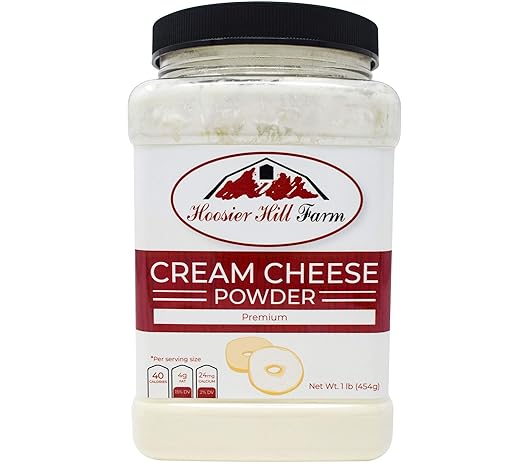
Hoosier Hill Farm Cream Cheese powder, 1 Lb. Gluten Free and rBGH and rBST free.
  1. Cream cheese powder, like this one from Hoosier Farms.  On a scale of 1 to 10, with 1 being "somebody's trying to poison me" and 10 being "go away, I'm eating this cheesecake by myself", this product, mixed exactly according to directions on the package rates a solid 1.  It was runny.  I couldn't even ask my family to try it.  It was so, so, so nasty.  
  2. Cream cheese powder, the same from above, but mixed with homemade plain yogurt instead to thicken it up and maybe improve flavor and mouth feel.  On the same scale of 1 to 10, this rated a 2.  It was thicker but still had an off taste to it.  
  3. One person on a preparedness forum indicated that she added one tablespoon of butter powder per cup of yogurt to make a cream cheese substitute very similar to Philadelphia cream cheese.  I think she hasn't bought Philadelphia cream cheese or any brand of cream cheese in a very long time.  It tastes ok, meriting perhaps a 4 or 5.  Members of my preparedness class tonight thought it would work as a base for a chip dip, with the right herbs.  It was definitely nothing like cream cheese.  
  4. Cream cheese substitute from plain yogurt.  Per numerous recommendations online, I drained and salted some of my homemade yogurt.  I think I'd give this a 5 as well, better than the others, but nothing you'd want to eat a lot of.  
  5. My fifth and final attempt at making cream cheese from food storage items involves the recipe below, the ingredients and instructions for which come exactly from Bigger, Bolder Baking.  However, I did adapt the ingredients to using a whole milk substitute that is completely from food storage.  Like the others, this did not turn out well, either.  To be fair, I am using a whole milk substitute.  Also, from what I have read from other sources, cream cheese is much easier to make and tastes better when the milk is not homogenized, and most store-bought milk is.  
I feel the cards are truly stacked against preppers when it comes to cream cheese.  I just don't think it's happening for us.  And again, what was my point in posting recipes that don't work?  So that you have them to refer to when you get the idea that you can make cream cheese yourself.  Because sooner or later, you might want to give it a try.  To keep from wasting precious resources, you can at least make a more informed decision about what to try, or whether it might be better to give up and try something else.

For me, right here and right now, I'm giving up.  I think I will not pursue the quixotic quest for cream cheese any further.  At least, for now.  Maybe we should just get some goats.

Bigger, Bolder Baking's Homemade Cream Cheese
Ingredients
  • 4 cups (32oz /1000ml) whole milk (full fat, not low fat)  (1 1/3 cups p milk plus water to make full quart.  4 teaspoons honey, 1/4 cup butter powder   
  • 2-3 tablespoons lemon juice (lime juice or white vinegar)
  • 1/4 - 1/2 teaspoon salt (read notes)
Instructions
  1. In a heavy-bottomed saucepan, heat the milk on med-high. Stirring constantly until it starts to a rolling simmer.
  2. Reduce the heat to medium. Add the lemon juice 1 tablespoon at a time, in 1-minute intervals. Continue stirring constantly.
  3. Continue cooking until the mixture curdles. Stir constantly till the mixture has separated completely, this should take just a few minutes. There will be a green liquid on the bottom and thick curdles on top. Remove from the heat. This should happen within a few minutes.
  4. Lay a sieve with cheesecloth over a large bowl. Pour the curd mixture into the sieve. Let it strain and cool for about 15 minutes.
  5. Transfer curds to a food processor and process until curds have come together and are totally smooth and creamy. It will take around 3-4 minutes. Keep going if your cream cheese is grainy.
  6. Add salt and taste. Add more if you want more flavor. Now is also a good time to add herbs, garlic or any other flavors you like.
  7. This cream cheese must be stored in the fridge. I always use it within 7 days but can last as long as up to 2 weeks.

Links to related posts:
Making Thick and Creamy Yogurt


For further reading:
https://www.biggerbolderbaking.com/how-to-make-cream-cheese/
http://preparetodaywardnewsletter.blogspot.com/2014/09/my-food-storge-week-in-review-yogurt.html

© 2019, PrepSchoolDaily.blogspot.com

Thursday, August 15, 2019

Bucket Wrenches

So I'm sitting in bed here, as I do most mornings, banging out another post.  The house is quiet; my husband and daughters left for the favorite archery tournament of the year in Nevada City over an hour ago.   Without interruptions, I ought to be able to write quickly, which is good, because I'm a little more pressed for time than usual.  I've got the usual Saturday morning stuff to do, plus a bridal shower this afternoon.  For my soon-to-be daughter-in-law.  My very first.  :)
Anyway, KOTPE and Buttercup's primary wedding gift from us is a year's supply of food storage, plus some furniture.  I'm not wrapping up any of those items to take to a shower.  However, at the same time, giving them food storage without a bucket wrench reminds me a bit of one of the best Far Side comics ever.  You know, the one with the old couple in a basement bomb shelter full of canned goods, and a mushroom cloud in the sky above the house.  And the wife says to her husband, "How many times did I say it, Harold?  How many times?  'Make sure that bomb shelter's got a can opener--ain't much good without a can opener.'"

So what will Buttercup be receiving from me today?

Bucket wrenches.  Yeah, I guess I'm that kind of mother-in-law. 

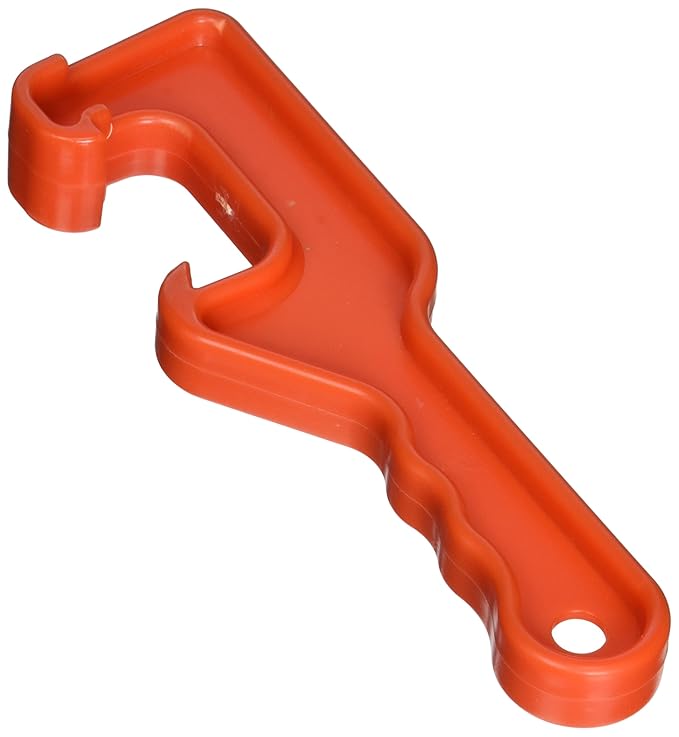
For the more tool-oriented readers, these are also called bung wrenches or drum bung wrenches.  Now, most men don't actually need these bucket wrenches.  They've got all the finger strength in the world to open bucket lids.  However, it is a totally different matter for women.  And while I could open these bucket lids with great effort without a wrench in my twenties, by the time I hit thirty, that was no longer an option.  It can be hard enough to rotate food storage when it's easy.  Don't make using your long-term storage in buckets any harder by not having a bucket wrench.  And just because these wrenches are inexpensive, don't assume that they're indispensable.  You really need at least a couple.

They come in several colors, and while I would like to have gotten blue (Buttercup's favorite color), our WinCo only had yellow last night.  Amazon and every food storage company on the planet sell them for somewhere between five to ten dollars, but WinCo's got them for under two dollars. 


Linzer 5425 Plastic 5-Gallon Paint Can Opener, Orange

Unless you are using gamma lids on everything, you'll probably want to have a few of these on hand to get into your buckets.  Some choose to spend the money for gamma lids, but at seven dollars per lid, well, say you've got a hundred buckets.  One for each bucket would be $700.  Or get a couple of bucket wrenches and spend the difference on more food.  That's not a difficult decision to make.

You probably only need a couple, but if you've got a daughter like mine ("QOTPE"--Queen of the Picky Eaters), she'll say something to wig you out and make you get more.  I can't remember her exact words, but I already had six wrenches and whatever it was she said, I had to buy two more.  It is nice to have them in all the locations where we have the buckets.

Links to related posts:
Long Term Food Storage  

© 2019, PrepSchoolDaily.blogspot.com  

Monday, August 12, 2019

Medicinal Uses of Arrowroot

Disclaimer.  I am not a licensed health practitioner.  This is just another post on an item you might wish to have available if needed so that a physician can treat you and your family as best as possible.  No medication, including those available over the counter, should be taken without consulting a physician.  Information shared here is for educational and entertainment purposes only.  It is not medical advice nor a substitute for licensed medical care.  A qualified, licensed physician or other medical provider should be consulted before beginning any herbal or conventional treatment.


Arrowroot, Maranta arundinacea, is a tropical plant native to the Americas.  It is most often used today as a thickener for food, a non-GMO alternative to cornstarch.  Arrowroot isn't commonly used at home as food in our society today, except by those individuals who are on gluten-free diets and/or needing an alternative to cornstarch.

Unfortunately, it is highly unlikely that you are able to grow arrowroot in your area.  That fact alone is often a deal-killer for me, but I have been known to make exceptions, especially for medicinal items with a respectable shelf life.  If you can grow it in your area, you'll have a powerhouse of nutrition at your fingertips.  A one-cup serving of arrowroot contains impressive amounts of several vitamins and minerals, including vitamins B1, B3, and B9, calcium, potassium, magnesium, and phosphorus.

As you do your own research into arrowroot powder and determining whether this is something you want in your stores, keep in mind that arrowroot powder and arrowroot flour and arrowroot starch are all the same thing.  Also, when using arrowroot to replace cornstarch, start with substituting 1/3 to 1/2 of the amount of cornstarch the recipe calls for.   Be sure to make a slurry, you know, like you do with cornstarch or flour, mixing the arrowroot powder with a small amount of water or other liquid, before stirring it into the soup or gravy or whatever.  Also, be sure to stir the arrowroot slurry into the soup right before serving, as high heat breaks down the thickening qualities of the arrowroot.

Arrowroot has a shelf life of at least 3-4 years when properly stored.  

However, the culinary uses of arrowroot are not the focus of this post today.  Honestly, I probably wouldn't bother with arrowroot for its uses in food.  No one in my immediate family is bothered by gluten issues, and while I do try to avoid all the genetically-modified food I can, I don't stress too much over cornstarch as we really don't use it that often.


Historically, arrowroot was highly valued for its medicinal effects, and that's what we're interested in today.  Arrowroot especially developed a reputation for its efficacy against poison arrow wounds and snake and spider bites, but it's got a lot of other interesting uses, too.  Fortunately for those readers living in tropical areas, the active constituents of arrowroot are also found in other plants:  Florida arrowroot (Zamia integrifolia, cassava (Manihot esculenta), and kudzu (Pueraria lobata).  The rest of us will have to buy it.

INTERNAL USAGE
Arrowroot is mixed into juice, water, or some other drink, about two teaspoons per cup of liquid, and then taken to relieve the following conditions:
  • Gastrointestinal conditions, including:
    • Upset stomach
    • Diarrhea and dysentery
    • Food poisoning, to treat and as a preventative, may be added to soups, gravies, and other liquids.
    • Irritable bowel syndrome
  • Urinary tract infection.  
    • Bladder infections and cystitis
    • Also, may be taken daily to prevent recurrence of these infections.
  • Teething pain in infants.
    • Arrowroot biscuits have been around for ages.  Arrowroot powder may be applied directly to the gums, or it may be used as flour and baked into biscuits for teething.  
  • Boost immune system.  
  • Venomous snake and spider bites.  Arrowroot juice or tea was historically administered to treat these bites.  However, I could find no mention of modern usage. 

EXTERNAL USAGE
Historically, arrowroot powder was mixed with a little bit of water to make a paste and then applied directly or in a poultice to treat the following:
  • Venomous snake and spider bites.  
  • Smallpox
  • Poison arrow wounds, infected wounds, including gangrene.

Contraindications:  None.  Safe for babies and pregnant and nursing women, when used in normal quantities.  Sitting down to a meal of arrowroot only is not a good idea.  Just like eating a cup of salt is not a good idea.

Caution:  Do not take arrowroot powder in conjunction with any other medications or supplements to alleviate diarrhea.  You risk extreme constipation.  

For further reading:
https://draxe.com/arrowroot/
https://www.yourhealthremedy.com/medicinal-plants/arrowroot-powder-uses-health-benefits-side-effects/
https://www.organicfacts.net/health-benefits/other/arrowroot.html
http://www.scielo.br/scielo.php?script=sci_arttext&pid=S0004-28032000000100005&lng=en&nrm=iso&tlng=en  (diarrhea treatment in IBS)
https://parenting.firstcry.com/articles/arrowroot-for-babies-benefits-and-recipe/
https://www.thehealthsite.com/diseases-conditions/prevent-recurrence-of-uti-with-arrowroot-powder-bs915/
https://www.ncbi.nlm.nih.gov/pubmed/15453588
https://draxe.com/homemade-probiotic-deodorant/moistening and a nourishing effect on the body.
https://downshiftology.com/5-things-you-need-to-know-about-arrowroot-powder/
https://stilltasty.com/Fooditems/index/16412


© 2019, PrepSchoolDaily.blogspot.com  

19 jul 2021

17 june 2024

    Tuesday, July 30, 2019

    The Problem with Zebras

    "When you hear hoof beats, think horses, not zebras."

    That was one of the gems that Dr. Steve shared in his off-grid medicine course.  It's something taught to all students in medical school.  And what is means is this:  Common things happen commonly.  The child in the waiting room is more likely to have an ear infection than appendicitis.  The young adult is more likely to have type-2 diabetes than a gunshot. 

    We naturally gravitate toward the sensationalized rather the common.  If we decide to learn something new, it has to be something cool, different, unique.  Quick and easy would be really good, too.  Macho survivalists want to learn how to DIY an appendectomy on themselves, sans anesthesia.  But learning to satisfy the essentials of good nutrition to stay healthy in the first place?  Leave that to the grannies. They want to be able to stitch up that GSW or finish off an amputation or place a tourniquet (and argue about which tourniquet is best).  They want to be able to treat the rare injuries, the zebras, that likely aren't even once in a lifetime or once in a family's lifetime, but can't manage the common problems (the horses).  They don't know which OTC meds are best for which conditions or when to suture and which wounds must be left open.

    Spending money on stuff is easier than learning a new skill. The acquisition of that box of ammo, bottle of fish antibiotics, or solar rechargeable penlight provides an immediate reward of having accomplished something.  And with online shopping, you receive that reward twice--once when you purchase, and again when it arrives.

    Learning a new skill takes time. It's not glamorous or sensational.  On top of that, the macho guys are even ridiculing your choices, which makes it harder.  They're sure the hoof beats coming are zebras, and it's silly to waste time preparing for horses, mules, or donkeys.  So you just have to put your head down and plow on.

    Which brings us back to the problem with zebras.  For a very long time the US, figuratively, has been a nation of horses treated by horse doctors, horse doctors that have been trained to treat only horses.  Not zebras.  Even though zebras bear some physical resemblance, there are significant differences.  Because the zebras carry some vastly different diseases.  And those diseases have symptoms and presentations that are quite similar to those for horses, but the treatments may be totally different.  The horse doctors might have read about these zebra diseases, but they have never seen them.  Most American doctors have never seen even one case of the following:
    • diphtheria
    • tetanus
    • rabies
    • scabies
    • mumps
    • German measles
    • cholera
    • yellow fever
    • typhus
    • tularemia
    • plague
    • anthrax
    • botulism
    • measles (though this is changing with increasing numbers of people who are not immunized)

    When American doctors hear hoof beats, they think horses. Scabies gets diagnosed as psoriasis.  Improperly diagnosed rabies patients are given steroids for pain and sent home.  Is it influenza, or anthrax?  The symptoms are very similar. What about plague or tularemia?  Even with experience, these can be hard to differentiate.  Without experience? You probably don't want to go there.

    Unfortunately, many of those hoof beats in the distance are in fact coming from zebras.  Most physicians in US have never seen the actual zebras making a comeback and crossing our borders.  Measles is only the beginning.  Lots of other communicable diseases are on their way.   We currently have the problem of physicians unable to identify more exotic diseases now, while the technology is available to help them.  What happens when our society collapses?  They will not have their technology to help them diagnose anything.

    Now, there are a few horse doctors who hear the hoof beats of zebras in the distance.  Some of them teach off-grid medicine to preppers.  Some write books or blogs.  No one physician covers everything, so it's best to acquire at least two or three different sources--hard copies.  Make sure you're prepared to deal with the ailments common to horses.  That's what you'll see the most of.  But it would also be wise to have the means of dealing with communicable diseases, parasites, and infectious diseases of third world countries, as well as bioweapons.  Zebras can be heard in the distance.

    Links to related posts:
    Cholera
    Rabies
    Scabies
    Tularemia 
    Typhus
    Armageddon Medicine  
    Survival and Austere Medicine, 3rd Edition  
    The Survival Medicine Handbook 

    For further reading:
    https://www.deseretnews.com/article/900041016/utahn-dies-from-rabies-a-first-since-1944.html
    https://www.healthline.com/health/psoriasis/psoriasis-vs-scabies

     © 2019, PrepSchoolDaily.blogspot.com  04.23.24

    Monday, July 22, 2019

    Medicinal Uses of Plantain

    Disclaimer.  I am not a licensed health practitioner.  This is just another post on an item you might wish to have available if needed so that a physician can treat you and your family as best as possible.  No medication, including those available over the counter, should be taken without consulting a physician.  Information shared here is for educational and entertainment purposes only.  It is not medical advice nor a substitute for licensed medical care.  A qualified, licensed physician or other medical provider should be consulted before beginning any herbal or conventional treatment.

    This article is on the medicinal uses of the weed plantain (Plantago spp,), rather than the fruit that looks like a banana.

    Harvest:  For fresh use, pick when you need it.  To dry for later use, gather plantain leaves after the flower spike has formed. Plantain leaves are eaten fresh in salads or cooked and eaten like spinach.  The seeds from the flower stalks can be sprinkled on food to add fiber to the diet.  However, plantain's greatest value comes from its medicinal properties.

    Medicinal Use:  Plantain in its various forms has been used historically to treat:
    • asthma, bronchitis, emphysema
    • fever
    • bladder problems 
    • hypertension
    • rheumatism
    • venomous bites or stings (snake bites, bee stings)
    • contact dermatitis (poison oak, ivy, sumac)
    • sores and wounds
    • burns
    SPIT POULTICE:  
    • Insect bites and stings.  Everyone in the family should know where plantain is growing in the yard and how to make a spit poultice with it in an emergency.  Pick the leaves, chew them a bit, and slap them on to relieve the pain and itching from bug bites and stings and poison ivy, oak, and sumac.  Secure in place with gauze and tape.  If you're using this on another person who is going to be squeamish about having your saliva on his body, crush the leaves in your hands or with a rock and then apply directly to the skin.  It takes a little longer, but squeamishness has its price.  While you're treating the patient, especially if the patient is young, distract him from the pain by telling him how the poultice works.  Something along of the lines of, "Crushing the leaves releases the mucilage, which soothes the pain.  The anti-inflammatory effect reduces swelling.  Because the spit poultice also draws out toxins, the venom that makes you itch, the sooner it is applied, the faster and better it works."  Replace as needed to relieve pain.
    • Contact dermatitis (poison oak, poison ivy, poison sumac).  Apply a poultice immediately and leave on for 30-60 minutes.  Then wash the area with plantain tea (see below).  Finally, apply a plantain sludge.  Replace as necessary.  
    • Burns.  After cooling in running water for 10-15 minutes, apply a poultice and secure with gauze and tape.  Two hours later, follow up with a plantain salve (see below).   
    INFUSION
    In most of the country, plantain is a weed that grows in abundance, and as such can be used for chronic conditions.  We have so little of it that we're saving it for insect bites and stings.  However, if you've got a lot of it, here's how it can be used.

    Internally:  Steep 1/2 cup of fresh or 1/2 teaspoon of dried plantain leaves in 1 cup of boiling water, covered, for 10-15 minutes.  Strain to remove leaves.  Add honey or sugar if desired.  Drink three times per day to relieve:
    • diarrhea, stomach ulcers, IBS, gastritis
    • colds, hay fever, asthma, emphysema, bronchitis, influenza, fever, sinusitis, coughs
    • hypertension
    • rheumatism, goiter
    • PMS, irregular menstrual flow
    • bladder problems, cystitis, kidney stones,
    • irregular liver and kidney function (only 1-2 times per day)
    • blood sugar swings in diabetics

    Externally:  Prepare the infusion as above, without adding sweetener.  Use the plantain tea in the following ways:
    • wash wounds, rashes, eczema;
    • gargle to reduce mouth ulcers and throat pain and infection (2 tablespoons 4 times per day);
    • wash eyes to relieve irritation.

    SALVE
    Using the fresh leaves is generally the easiest way to go.  After all, you get just the right amount and you don't have to store it inside anywhere.  And then have to try finding it quickly.  But, we're preppers.  And sometimes you can't find plantain outside when you need it.  Like when winter lasts nine months. This salve combines the healing effects of plantain with the soothing properties of coconut or olive oil.  Use the salve for:
    • rashes, eczema, psoriasis, contact dermatitis;
    • burns and blisters;
    • insect bites and stings;
    • acne and boils;
    • cuts;
    • sprains;
    • hemorrhoids;
    • drawing out thorns or splinters;
    • reducing scarring on more serious cuts and scrapes;
    • dandruff (rub into scalp, leave on for an hour, wash hair).
    Here's how to make your own plantain salve:
    • Fill a glass jar to the top with washed, dried, and crushed fresh leaves, or half full with dried leaves.  
    • Add in melted coconut oil or olive oil to cover the leaves.  
    • Replace lid and let sit in the sun for two weeks.  
    • Warm oil if necessary and strain out the leaves.  
    • In a double boiler, melt one ounce of beeswax per seven ounces of infused oil to make a firmer salve.  
    • Store in a cool, dark place. 
    TINCTURE:
    Use a plantain tincture for the following conditions:
    • For internal use, 10 drops in 1 cup water, 3 times per day:
      • upper respiratory infections (best if tincture is added to hot water with a spoonful of honey;
      • gastrointestinal complaints;
      • sore throat, 10 drops in 2 tablespoons water and gargle or swish for 30 seconds.
    • For external use:
      • dilute 10 drops in 1 tablespoon water and apply to boils, acne, and sores to prevent infection and promote healing.
    Here's how to make a plantain tincture:
    • Wash and dry fresh leaves, crush them, and put them in a glass jar.  Pour 100-proof alcohol into the jar, completely covering the leaves and filling the jar.  Replace the lid and shake the jar well.  Place the jar in a cool, dark place, and shake it every day for 6-8 weeks.  Strain out plantain leaves and pour tincture into a clean jar.  Label and date.  Your tincture should last for at least 2-3 years.  
    DECOCTION:
     A decoction of plantain roots is used in treating everything listed above, so I'm not going to repeat the list here.  However, the roots are a little stronger in treating two important conditions.  Prepare a decoction by putting one tablespoon of washed plantain root in a small pan.  Add one cup of cool water and bring it to a boil.  Boil for 30 minutes.  Cool to drinking temperature and strain off the plantain roots.  Drink the decoction.  Use this decoction for the following:
    • Smoking cessation as needed.  Apparently it causes a natural aversion to tobacco.  
    • Venomous snake bites.  In addition to applying plantain spit poultices to the bite, also make this decoction for the patient to take internally.  
    • Ringworm.

    DRIED SEEDS:
    The seeds can be dried and infused in water for a soothing eye wash (after the seeds are removed), as a laxative, and for intestinal worms in children.   Plantain seeds also help reduce nicotine cravings for those trying to quit smoking. 

    Contraindications:  Plantain is considered a very safe her to use; however, it may cause minor dermatitis in some individuals.  Because there is no research indicating its safety, pregnant and breastfeeding women should avoid using it.

    Links to related posts:
    Echinacea
    Snake Bites
    Spider Bites 
    Kidney Stones
    Cream of Tartar and Smoking Cessation  

    For further information:
    https://www.verywellhealth.com/plantain-benefits-4579819
    https://www.healthbenefitstimes.com/plantain-herb/
    https://www.webmd.com/vitamins/ai/ingredientmono-677/great-plantain
    http://herballegacy.com/Ahlborn_Medicinal.html
    https://wellnessmama.com/4638/plantain-herb-profile/
    Sam Coffman, The Herbal Medic.
    Dr. Patrick Jones, The HomeGrown Herbalist, pp 159-164.
    Rosemary Gladstar's Medicinal Herbs, pp 190-191.

    © 2019, PrepSchoolDaily.blogspot.com

    9 october 2023