Thursday, October 31, 2024

Good Eats at the TEOTWAWKI Café—Tabasco Sauce

I’m going to be brutally honest here.  I haven’t actually made this Tabasco sauce.  No one in my family has.  I’ve never tasted homemade Tabasco sauce.  I used commercially prepared Tabasco for the first and only time in my life a couple of months ago, so that I could make some other sauce recipe—can’t remember which—and that recipe called for only one drop of Tabasco.  I opened a little sample bottle that came with a picnic basket my husband received from a previous employer.  That company knew how to treat its employees nicely.  But I digress.

So my family and I would not be good judges anyway as to whether this recipe was any good.  But just because we don’t eat it, that doesn’t mean that other families don’t.  My dad sprinkled it on scrambled eggs.  And that was the extent of my knowledge about Tabasco sauce.  I didn’t even know that there are things called Tabasco peppers.  Nor did I know that real Tabasco sauce is fermented—for three years!

Without that long ferment time, real Tabasco peppers, and McIlhenny company trade secrets, your Tabasco sauce will not taste just like store-bought.  But you can come close.  Check out the following recipes:

Fermented Tabasco Sauce

5 ounces Tabasco peppers, roughly chopped

2 tablespoons salt (plus ¼ teaspoon salt, if draining the brine)

1 quart water

1 cup white wine vinegar

Ferment the Tabasco peppers by packing them into a jar, leaving at least 1 inch of head space.

Next, mix 1 quart unchlorinated water with 2 tablespoons salt. Pour just enough brine over the peppers to cover them, pressing them down a bit as you go.  Note that the peppers may rise while fermenting.  Check the peppers daily to be sure they are covered with brine. 

Replace the lid and set the jar away from direct sun.  Let ferment for at least 1 week at temperatures ranging between 55 and 75°F. 

Most fermentation occurs between the first and second weeks.  Closely monitor the fermenting peppers during this period and “burp” the jars frequently by loosening the lid a little to release some of the gases.

The fermenting process will slow after the second week, and the brine will become cloudy and taste acidic.  When you reach this point, you have three options for producing your Tabasco sauce:

1.  Pour the fermented peppers and brine into a pot along with the vinegar.

2.  Strain and discard the brine; put the solids in a pot with vinegar and ½ cup water or more as desired + ¼ teaspoon salt.

3.  Use some of the brine for a thicker sauce. Keep in mind that the more brine you use, the saltier your product will be.  Bring to a rapid boil. Reduce heat and simmer for 15 minutes.

Cool slightly then add to a food processor. Process until smooth.

Strain the mixture to remove the solids. Pour into canning jars. Adjust the volume with additional water and/or vinegar, if desired.

Note that the fermented version tastes more mellow than the unfermented version.


Un-Fermented Tabasco Sauce

5 ounces Tabasco peppers

1 cup white wine vinegar

¼ teaspoon salt

In a small pot, combine the peppers, vinegar, and salt.  Bring the mixture to a boil, and then reduce the heat and simmer for 15 minutes to soften.  Cool the mixture slightly, and then pour it into a food processor. Process until smooth.

Strain the mixture to remove the pepper seeds and solids.

Pour into canning jars. Adjust the volume with additional water and/or vinegar, if desired.

Notes: Each version makes about 1 cup unstrained and ½ cup strained.   “Tabasco” sauce may be made with any type of hot pepper, but other peppers will not yield the true “Tabasco” flavor

Green Tabasco Sauce

10 green jalapeno peppers, stems removed

1 cup distilled white vinegar

1 teaspoon salt

In a saucepan, combine the peppers, vinegar, and salt, and bring the mixture to a boil.  Then reduce heat and simmer for 10 minutes.  Remove saucepan from heat and let the mixture cool.  Transfer the mixture to a food processor and blend until smooth.

Pour the mixture through a wire strainer to remove solids.  Pour the sauce into canning jars and store in the refrigerator for up to 1 month.

Wednesday, October 30, 2024

When It’s Time for the Rainbow Bridge

I don’t know where that phrase comes from, but it’s always associated with the passing of a beloved pet.  We knew that time was coming for Max, our Great Pyrenees rescue who had surpassed the average GP lifespan by two years already.  He was losing weight and drinking a lot of water, which suggested diabetes.  However, blood glucose tests showed normal blood sugars.  He was just getting old, and probably had some other problems, but what’s the vet going to say?  Lab work.  Meds.  And he’s really old. 

I’d repeatedly suggested to Aaron that it might be time to put him down, but as far as we could tell, Max wasn’t in pain.  Yeah, he moved a little slower.  I move a little slower.  I’m not ready to take that dirt nap yet.

So Aaron dug the hole with the tractor, but wasn’t comfortable doing more than that.  We had the supplies a very trusted friend with decades of farm animal experience had recommended.  Our Plan A when the time arrived.

Yeah, we had Plan B, too. 

Aaron and I left home Tuesday morning for a quick visit with friends before continuing on to Utah on Wednesday to sell books at a preparedness expo for three exhausting days.  We stayed with Jared and his wife, and since we weren’t able to visit with them while working the event, opted to stay an extra day, planning to head home Monday morning.

Becky was home holding down the fort.  And that’s when Max began his final downward spiral.  It started a few hours after our initial departure, but very slowly so Becky figured it wasn’t worth mentioning.  Until 12:30 Monday morning.  He was suffering.

As recommended, Plan A for Max’s departure from this sphere of life involved a couple of Benadryl tablets to calm him down followed by ether over the nose until he drifted blissfully to sleep permanently.  Becky just needed to know where the ether was. 

Unfortunately, the ether bottle, which had never been opened (but which always had a strong odor about it so I should have suspected something) had leaked and evaporated.  There was only about 2 teaspoons remaining.  I hadn’t ever thought to check the contents.  The potential for evaporation/leaking hadn’t occurred to me.  We hadn’t ever used the ether in the past 10 years, so I wrongly assumed it was still there and usable.  Unfortunately, those last 2 teaspoons were nowhere near enough for an extra-large dog.  Yes, another bottle was just ordered from Amazon.  (I thought about getting a metal bottle like last time, because there isn’t the risk of the bottle breaking.  However, I chose the amber glass bottle because I want to be able to see whether the ether is still in there.)

Plan A was no longer an option.  We were both hoping there would be some way to avoid the Plan B route, but I wasn’t optimistic. 

The overwhelming majority of websites don’t provide any helpful information.  “Only a vet can euthanize your dog.”

Benadryl:  It would be nice if our pet could just drift off to sleep.  This paper suggests a dose of ten 50-mg tablets for a 40-pound dog.  (Adjust calculations for your own dog’s weight.)  As is often the case, however, swallowing pills won’t work when a dog is seriously ill. 

Carbon dioxide chamber:  This website offers instructions on creating a carbon dioxide chamber for euthanizing animals less than 2 pounds in weight.  So it wouldn’t work well for dogs.

Other websites recommended a carbon monoxide chamber—basically the equivalent of turning the car on and closing the garage door.  It seems a bit risky to me, and besides, you wouldn’t be able to be with your pet. 

The original Plan B would have to be enacted.  Becky retrieved her pistol while I searched for the specifics.  The following comes from the Internet Center for Wildlife Damage Management.

The muzzle of the gun should be 1.5 to 2.0 inches from the animal’s brain when using a .22 cal long-rifle mushroom shell or a .410 shotgun with slugs or pellets. The gun muzzle should be 39 to 78 inches away from the animal’s brain for larger firearms, such as a .308 rifle.

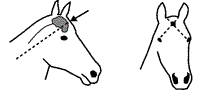
In general, the bullet should pass through the brain toward the spine. While exact placement differs slightly for each species, the rule of thumb is to draw an imaginary line between the right eye and left ear and the left eye and the right ear. The two lines will intersect at the bony ridge of the skull. Try to place the bullet just off-center of the intersecting point to avoid the bony ridge. Direct the bullet so that it will pass through the brain toward the base of the skull – where it attaches to the spine. This way, the bullet will cause a great deal of tissue damage and ensure a more humane death.

dog shot 


sheep shot

horse shot

(Images from ICWDM.org)

Keep in mind that even a well-placed shot may result in violent convulsions of your pet.  Remember, your pet is now unconscious, feeling nothing.  This is still a humane death, and in reality, much more compassionate that taking him down to the vet to die in a sterile environment far from home.

References:

https://icwdm.org/management/shooting/shooting-as-euthanasia/    

https://www.outdoorlife.com/blogs/gun-dogs/2009/11/how-kill-your-dog/   

https://vetmeds.org/pet-poison-control-list/acetaminophen/#!form/PPCDonations  https://keepingdog.com/your-how-much-benadryl-is-fatal-for-a-dog/  http://www.alysion.org/euthanasia/

Tuesday, October 29, 2024

Caring for a Low-Birth-Weight Newborn in a Collapsed Society

One of the great blessings we experienced this summer was the arrival of grandchild #3, son of KOTPE and his wife, Buttercup.  And he challenged us with drama all along the way.  The first was the usual just trying to get through the first trimester alive; his mom already had a record of miscarriages.  Then came the more frequent doctor visits because she was now classified as being high-risk.  And sure enough, right in line with his older sister, Sweet Pea, and his older brother (who went straight to heaven), he was not gaining enough weight.  Growth-restricted is what they call it.

That qualified him and his mom for weekly doctor visits, half of which were a four-hour drive to the big city.  Fortunately, KOTPE took those days off work so he could drive Buttercup to those appointments.  He seemed to be doing pretty well and hovered around the 7-10th percentile for growth.

But at 34 weeks, when Tiger dropped below the 3rd percentile for growth, that got his mom scheduled for an induction 3 weeks early.  At least he had dropped into birth position and indicated that he was ready to move on to his next stage of life.

However, not wanting to miss the opportunity to squeeze a little more drama in, the night before he was to arrive, he decided to flip.  Breech position.  No good.  And no amount of manipulation by the doctor was going to persuade him to flip back into birth position.  Then he started exhibiting signs of distress.  That warranted an emergency Caesarean section.  Bummer.

Tiger arrived on the scene at a not-so-whopping 4 lbs 8 oz. 

Even now with functioning hospitals, there’s not much anyone can do about a growth-restricted baby (and anecdotal reports from a few people I know in OBGYN/ultrasound positions indicate a significant increase in growth-restricted babies since COVID).  Most of us aren’t going to be prepared for a c-section.  But we can prepare for low-birth-weight babies. 

In all the off-grid texts that I have here, there is next to nothing about caring for newborns, especially sick and underweight newborns.  So I felt extremely fortunate today to stumble upon another gem.  The Alaska Community Health Aide Practitioner Manual 1987 was written for the approximately 210 community health aide/practitioners (CHA/Ps) who deliver primary health care in rural Alaska.  These CHA/Ps receive only 10 weeks of formal training before beginning their work in rural villages.  Naturally, they rely on being able to connect with physicians by phone and they have all the desired supplies at their disposal, things we have a harder time procuring because we aren’t licensed. 

Nonetheless, this manual is a true treasure trove of information for individuals preparing for the challenging times ahead.  And the best chapters in this manual, in my opinion, are those relating to maternal and child health and mental health issues. 

So what does this manual have to say about caring for low-birth-weight babies?  Lots.

Low birth weight is defined as weighing 5.5 lbs or less.  This infant may also have:

  • Limp appearance/poor muscle tone
  • Soft and floppy ears
  • Little or no breast tissue
  • Few creases on the bottoms of the feet
  • Lots of fine body hair
  • Thin skin
  • Little fat under the skin

Begin care as for all newborns.  Check the Apgar scores and record them at 1 and 5 minutes after birth.  After drying the baby, loosely wrap his arms, legs, and torso in plastic wrap.  Make sure to keep a stocking cap on his head at all times.  Babies lose much of their body heat through the head.  Wrap the baby in a warmed blanket.  Make sure you can observe him without disturbing him.  Keep the baby in a warm area.  Assuming no incubator is available, improvise with a cardboard box with viewing holes and some water bottles. 

If the baby’s temperature drops below 97.6°F, do the following: 

  • Prepare hot water bottles. 
  • Wrap the hot water bottles with towels or blankets so that there is 2” of cloth between the bottles and the baby.  Place the hot water bottles in the enclosure with the baby. 
  • Check the baby’s skin often to prevent burns. 

Low-birth-weight babies are also at risk for low blood sugars.  (Low blood sugar in a newborn is defined as less than 30 mg/dL in the first 24 hours of life, and less than 45 mg/dL after that.  By the second to third day of life, the baby’s blood glucose levels should increase to the adult level of 80-120 mg/dL.)  Symptoms may include:

  • Bluish or pale skin color
  • Apnea (breathing pauses) or rapid respiration
  • Hypothermia
  • Jitteriness, grunting, or irritability
  • Poor feeding or vomiting
  • Tremors or seizures

The risk factors for low blood sugars in newborns include the following:

  • Maternal hypertension
  • Premature birth
  • Maternal or neonatal infection
  • Baby needing oxygen after birth
  • Maternal diabetes
  • Restricted growth of baby in the womb
  • High or low birth weight[1]

Armed with this information, I have added hot water bottles to my Amazon cart and will have them shipping soon.  I spied liquid glucose packages at the pharmacy last time I was in, so I’ll stop by on my next trip into town to pick some up.  And, of course, I am going to be printing up this manual in the next day or two. 

References:

https://ia600408.us.archive.org/32/items/Alaska-community-health-aide-practitioner-manual-1987/Community%20Health%20Aide-Practitioner%20Manual%201987_text.pdf


[1] https://www.stanfordchildrens.org/en/topic/default?id=hypoglycemia-in-a-newborn-baby-90-P01961

Monday, October 28, 2024

The Medicinal Uses of Sphagnum Moss

As I’ve noted repeatedly on this blog, inspiration for the topics that post here come from a myriad of sources.  Today’s originated as an article that appeared on the homepage of my browser.  Sphagnum peat moss has medicinal uses?  I had just gotten 14 bales of sphagnum peat moss for the garden at 85% off.  (Well, Aaron got them since he had the truck.)  Did we just win the lottery?

Not quite, as my further research revealed.

The article is a historical piece that first appeared in Smithsonian Magazine in 2017 (and misspells sphagnum several times).  And like the researchers who observed the orangutan applying a poultice to his wounds and thought they’d identified something unknown in the animal world, researchers who “identified” the medicinal uses of sphagnum moss during World War I thought they had discovered something new. 

As soldier deaths mounted in late 1914, doctors became desperate.  And one surgeon with an interest in botany recalled something of the historical use of sphagnum moss to pack soldiers’ wounds.  It was used anciently by the Irish in the Battle of Clontarf and later during the Napoleonic and Franco-Prussian wars.  We don’t know how ancients knew to apply this moss to their wounds, but they were onto something.  Sphagnum moss holds up to 22 times its weight in liquid, so twice as absorptive as cotton, and it is antibacterial as well. 

Millions of dressings were produced in Europe and North America to treat the wounded troops.  Communities located near the moss bogs organized “moss drives” to collect the life-saving substance.  Women, children, and even POWs on both sides were pressed into service. 

So why don’t we use moss bandages today?  Primarily because of the amount of labor required to collect the moss, but also because scientists say the peat bogs need to be preserved. 

And now for the question I had:  Can the sphagnum peat moss (which is how the bags are labeled) that I purchased as a soil conditioner from the feed store be used to make antibacterial dressings like were used during WWI?  Sadly, it appears, the answer is no.  What we purchase at nurseries and the big box stores to use in our gardens has been processed into fine particles and is dead-dead.  It should be properly called just peat moss.  The sphagnum moss used in bandages is only, to quote the words of the wizard in The Princess Bride, “mostly dead.”  As in 90% dead.  The dead cells are what absorb the fluids.  It should be referred to as sphagnum moss. It is light green and often used in crafting and creative planting presentations.

(All right, I have to admit I am still questioning this.  The Canadians harvested their sphagnum moss and then cut it down to size for use in bandages, sewed the bandages, and shipped the bandages to Europe for use in hospitals there.  Surely the sphagnum moss would dry out along the way, wouldn’t it?  And one reason we buy peat moss for use in the garden is to acidify the soil.  So wouldn’t this peat moss, if sewn into bandages, exhibit some of the same properties?  Inquiring minds want to know.)

Anyway, as you know, I write primarily on topics that will be of use to my family, and as we live nowhere near any peat bogs, we’re unlikely to ever cut our own moss for medical purposes.  So this article is for those of you who do live in such areas, as well as for all those who ever come across the information that sphagnum moss was used to treat soldiers’ wounds and wonder about the potential usage of sphagnum moss in the interesting times that lie ahead.

Links to related posts:

Animals Self-Medicate, Too

How to Make Dakin’s Solution 

Civil War Antibiotics in Georgia

References:

https://www.smithsonianmag.com/science-nature/how-humble-moss-helped-heal-wounds-thousands-WWI-180963081/ 

https://www.ncbi.nlm.nih.gov/pmc/articles/PMC1584876/pdf/canmedaj00338-0031.pdf

https://www.euppublishing.com/doi/abs/10.3366/anh.2015.0274?journalCode=anh