Disclaimer. I am not a licensed health
practitioner. This is just another post on an item you might wish to
have available if needed so that a physician can treat you and your
family as best as possible. No medication, including those available
over the counter, should be taken without consulting a physician.
Information shared here is for educational and entertainment purposes
only. It is not medical advice nor a substitute for licensed medical
care. A qualified, licensed physician or other medical provider should
be consulted before beginning any herbal or conventional treatment.
There are dozens of mosquito-borne diseases. Fortunately, most are
confined to the tropics and do not make it to the United States.
Unfortunately, international travel and extremely poor screening at our
ports of entry make some mosquito-borne diseases a threat to people
everywhere. Blog posts will cover only the diseases thought to present a
significant threat to people in the US.
Today's post will focus on yellow fever.
Yellow fever is a viral disease so named because of the jaundice
(yellowing of the skin and eyeballs) that occurs in the most serious
cases. Once bitten, the incubation period is generally 3-6 days. Most
people are sick for 3-5 days and experience the following symptoms:
- fever
- chills
- loss of appetite
- muscle pain
- back pain
- headache
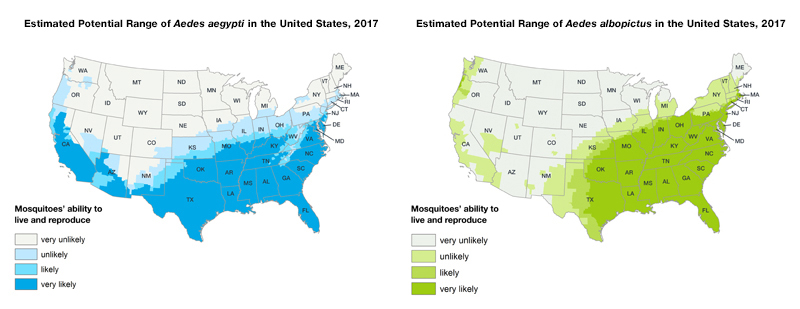
If the patient has recently arrived from an area where the Aedes aegypti mosquitoes (the most common vectors for yellow fever) live and breed, the outbreak may be contained. The maps below show the ranges for Aedes aegypti and Aedes albopictus (a less common carrier for the virus that causes yellow fever). Regardless of the distribution maps, what happens when people flee to escape a threat? They go to areas they perceive to be safer. With the speed of travel today, there is the potential for yellow fever to spread far outside these ranges.
We really don't hear much about yellow fever today; it's been a really long time since the United States experienced an epidemic. The epidemic of 1793 in Philadelphia (then capitol of the United States) prompted George Washington and the rest of the government to flee. At that time, nine percent of the population died due to yellow fever. Molly Caldwell Crosby's The American Plague details the yellow fever epidemic in Memphis, Tennessee, in 1878, where more than 20,000 were killed after a particularly rainy year in that area. And in yellow fever, we have another example of where starvation and disease kill more than war itself--more men died of yellow fever than in the battles of the Spanish American War in 1898. It was rightly considered one of the most dangerous diseases in the world during the eighteenth and nineteenth centuries.
Yellow fever remains a concern today, especially in Africa and South America. In 2013, there were 127,000 severe cases, mostly in Africa, and 45,000 people died. Of interest to those of us who prepare for interesting times ahead is the fact that yellow fever has been researched as a potential biological weapon.
Mosquito bites are prevented in the usual ways--mosquito repellent and covering the body as much as possible. Also note that the Aedes aegypti mosquito, unlike most other mosquitoes, feeds during the day.
Treatment of yellow fever is strictly supportive. Because it is a viral disease, antibiotics are not effective. There is a vaccine for yellow fever, and some countries require it for travel.
Antiviral herbs that have been historically used and found to be effective include elder, ginger, and licorice. Unfortunately, I could not find any information on dosages or frequency. Aspirin and other anti-coagulants should not be administered to a person with yellow fever.
Links to related posts:
Book Review: Herbal Antivirals
Catnip (mosquito repellent)
Permethrin (mosquito repellent and insecticide)
For further information:
https://en.wikipedia.org/wiki/Yellow_fever
https://www.cdc.gov/zika/vector/range.html
https://www.emedicinehealth.com/yellow_fever/article_em.htm#yellow_fever_pictures
https://www.cdc.gov/niosh/topics/outdoor/mosquito-borne/default.html
https://www.health.state.mn.us/diseases/mosquitoborne/diseases.html
https://deteroutdoor.com/blog/5-dangerous-diseases-transmitted-mosquitoes/
https://portal.ct.gov/Mosquito/Diseases/Mosquito-Transmitted-Diseases
http://npic.orst.edu/pest/mosquito/index.html
http://npic.orst.edu/faq/mosqtrvl.html
17 july 2019

the thing to remember about SHTFtimes is the possible destruction and eventual failure of current infrastructure >>> includes the engineered systems that prevent flooding - swamps, sloughs and entire lakes could re-appear where they were eliminated - the underground maze of city utilities and transportation will most likely flood permanently >>>> all breeding grounds for the pestilence that modern technology defeated
ReplyDelete