Tourniquets are still used by physicians today. All the time, like in the operating room. Placing a tourniquet does not mean the patient is going to lose the limb. Even so, it is better to lose a limb than a life.
This is not a post sharing the intricacies of proper tourniquet use. It's much better to learn that from a physician. However, having and using a tourniquet can save a life. The first thing to keep in mind is that a tourniquet is only used when all else fails--when up to half an hour of pressure has failed to stop bleeding or when the amount of blood being lost has the potential to be life-threatening. Tourniquets are only used on limbs, never on the abdomen or the neck. (If someone's wanting to use a tourniquet on the neck, it's probably best to assign that individual something else to do. Just sayin'.)
Sometimes two tourniquets are necessary to stop the bleeding, one two inches above the wound, and another two to three inches above the first. The first goal is to stop the bleeding and save the patient's life. The second objective is to save the limb.
When a tourniquet is placed, the exact time must be noted, and it should be noted in paper notes that the care provider is maintaining. The time must also definitely be noted on patient's body with a Sharpie marker. That information will govern the future attending physician's choices in how to handle tourniquet removal.
If you are in a situation where there is no higher care immediately available, keep the following in mind. Placing a tourniquet does not mean the patient will lose that body part. If the bleeding is so profuse that it can't be stopped by half an hour of direct pressure, the patient is at risk of dying. Something has to be done, right?
After the tourniquet has been in place for thirty minutes, the bleeding may have ceased, or at least slowed to the point where it can be managed with a pressure dressing and hemostatic agent like QuikClot.
If the tourniquet is removed within two hours, the limb can probably be saved. If the tourniquet is in place for more than six hours, the limb probably will not be saved. When a tourniquet is removed, do not irrigate the wound. That risks dislodging the clot and starting the bleeding all over again. When loosening the tourniquet, move it to just above the wound. Keep it in place in case it is needed again.
As far as which tourniquets to use, or whether to improvise, it's best to use a real tourniquet. It is much more difficult to improvise with strips of cloth or shoelaces. Put the money out for the real thing.
The two most popular tourniquets for field use are the SOFTT (Special Operations Forces Tactical Tourniquet; SOF-T as it's generally pronounced) and the SWAT-T. The SOF-T is very similar to the CAT (Combat Application Tourniquet) tourniquet, and both are used about the same. However, the SOF-T is made from higher quality materials. If you choose this tourniquet, make absolutely sure it is coming from an American company and made in America. Do not get one that's made in China.
The SOF-T/CAT is what is used by combat soldiers because it can be applied with one hand, even by the non-dominant hand, and done so very quickly. When blood is spurting out, every second counts. A person can die much more quickly from the loss of blood than from the loss of oxygen. Every person who carries a weapon should also carry a SOF-T tourniquet. Every time. And you need to practice with it a little bit before using it, but only a little bit. It's not at all difficult.
Like many things in life, the SOF-T has its pros and cons. It was initially designed for military use, and combat personnel generally have better developed muscles. It works very well for those people, but if you're dealing with someone with thin arms, like the elderly or young children, it's not going to work so well, or at all. Likewise, a certain amount of hand strength is required to use the SOF-T. So while this is what my husband and son carry, it doesn't work for me. I lack the strength in my fingers to use it effectively. Let's just hope I don't shoot myself in the arm.
What I carry is the SWAT-T (Stretch, Wrap And Tuck Tourniquet) tourniquet. It basically looks like one of those stretchy rubber exercise bands and comes in orange or black. I prefer orange; the bright color is more obvious and helps emergency responders notice it quickly. And I think it looks less threatening to children. With the instructions printed right on the tourniquet, it's pretty much idiot-proof. By just reading the instructions on the tourniquet and without any training at all you can be sure you are getting the right amount of tension for the tourniquet to work.
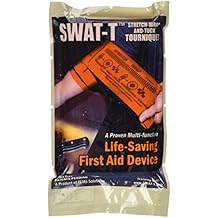 |
The SOF-T tourniquet is a tourniquet only. And it is kinda bulky in the medical kit. On the other hand, the SWAT-T is a multi-purpose item. It can be
used to make a shoulder sling or a pressure dressing, especially around the chest or abdomen. Like an ACE bandage, it can help stabilize a twisted knee or ankle. It may also be used to hold a cold pack in place. In a mass casualty
situation, it could even be cut in half to use on two children.
In short, the SWAT-T is less expensive, smaller, idiot-proof, and multi-purpose. I like it.
Links to related posts:
Bleeding
IFAKs

Just as the article indicates, there are Chinese knock-offs on Amazon, so be careful. This is true for so many items sold there.
ReplyDeleteI am not expert here, but I have read numerous articles that say that the "real deal" for the CAT Tourniquet can be bought at https://www.narescue.com/combat-application-tourniquet-c-a-t.html
I should have added to my comment that the Chinese knock-offs have been known to use cheap plastic for the windlass. The last thing you want to fail when a tourniquet is actually needed is the windlass. Without it, the tourniquet cannot be tightened.
ReplyDeleteYes - NARescue is a good source for the CAT.
ReplyDeleteFor that I am allowed by them to purchase their products for the same price everyone else does.