There are literally millions of different bacteria on this planet. When our medical system collapses, we will not have access to laboratories to identify which particular bug is making us sick. We and our doctors will be making our best guesses based on the symptoms, the patient history, and the bacteria that commonly cause both. And then, if it is believed that the cause for the illness is bacterial in origin, a treatment may be suggested. Industrial antibiotics, if they are even an option, may be advised for serious cases. Herbs will only be recommended by care providers who are familiar with them, and only if conventional pharmaceuticals are not an option or if herbs are the patient’s preferred choice. Many physicians just aren’t familiar enough with herbs to be comfortable prescribing them.
On the other hand, most physicians are quite aware of the ever-increasing problem of antibiotic resistance. This handy little chart I found on Wikipedia depicts the various classes of antibiotics and which bacterial strains they are used against. Unfortunately, antibiotic resistance is a rapidly growing problem and just because a bacterial infection is supposed to be eliminated by a specific antibiotic doesn’t necessarily mean that it will be. You can check the far left column of the chart and see that there are only three antibiotics currently effective against MRSA infections. And again, antibiotics have been winning the battle against resistance. How long before that number decreases to two antibiotics, and then one? And then zero?
In the year 1900, before the advent of antibiotics, more than 30% of all deaths were due to bacterial infections.[1] A few more fun facts from the same article:
- 19,000 deaths were caused by MRSA infections in the US in 2009, more than HIV and tuberculosis combined.
- 40% of Streptococcus pneumoniae strains were resistant to penicillin.
- 1.3 million individuals die of tuberculosis every year worldwide.
- 700,000 cases of gonorrhea occur in the US every year.
With that many illnesses being treated by antibiotics, the risk of developing more antibiotic-resistant strains is exploding. And there is a significant chance that we’ll encounter one or more of these resistant infections in our family members when professional medical care is hard to get.
So what can we do to ensure we can treat our loved ones?
First off, we have to make sure we’ve stocked the medicine chest with a good variety of antibiotics. If you take a look at the chart below, you’ll see there is a wide variety of antibiotics that a doctor could use to treat streptococcal infections. If one doesn’t work, he can prescribe another. Of course, that doesn’t work on everything, especially something like MRSA.
However, adding herbs to a conventional antibiotic treatment regimen often works very well, especially when dealing with antibiotic-resistant infections. And not only can these herbs defeat antibiotic resistance, at the same time they make the antibiotics more effective, thus shortening the course of treatment. So you can actually use fewer antibiotics and thus extend your supplies. So instead of having to take the antibiotics for 7 or 10 or 14 days to make sure the infection is good and gone, you may be able to get away with taking the antibiotic until 2-3 days after the fever has passed. Of course, all this would be based on your doctor’s recommendations.
The following herbs have been shown in clinical trials to exhibit synergism with antibiotics:
|
Conventional antibiotic |
Corresponding herb |
|
Ampicillin |
Berberines*[2], juniper[3] [4], thyme[5] [6], pomegranate[7] |
|
Bacitracin |
Thyme[8] |
|
Ciprofloxacin |
|
|
Clarithromycin |
Usnea[11] |
|
Erythromycin |
|
|
Gentamicin |
|
|
Oxacillin |
|
|
Penicillin |
|
|
Tetracycline |
*The berberines include Japanese barberry, Oregon grape, and Nandina domestica.
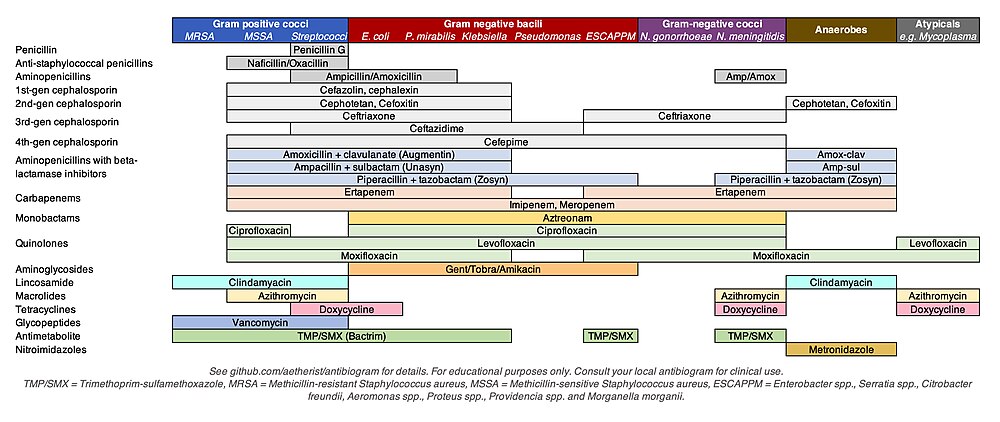
Chart copied from https://en.wikipedia.org/wiki/List_of_antibiotics
[1] https://www.cdc.gov/mmwr/preview/mmwrhtml/mm4829a1.htm
[2] Stephen Harrod Buhner, Herbal Antibiotics, 2012, 166.
[3] Stephen Harrod Buhner, Herbal Antibiotics, 2012, 186.
[4] Rajinder Raina, et al., “Potential of Juniperus communis L. as a Nutraceutical in Human and Veterinary Medicine,” Heliyon, August 2019, Vol 5 No 8, https://www.ncbi.nlm.nih.gov/pmc/articles /PMC6726717/ (accessed 2 February 2021).
[5] Stephen Harrod Buhner, Herbal Antibiotics, 2012, 215.
[6] K Palaniappan, et al., Use of natural antimicrobials to increase antibiotic susceptibility of drug-resistant bacteria, International Journal of Food Microbiology, Vol 140 No 2-3, 15 June 2010, https://www.sciencedirect.com/science/article/abs/pii/S0168160510001868?via%3Dihub (accessed 23 November 2021).
[7] Stephen Harrod Buhner, Herbal Antibiotics, 2012, 215-16.
[8] K Palaniappan, et al., Use of natural antimicrobials to increase antibiotic susceptibility of drug-resistant bacteria, International Journal of Food Microbiology, Vol 140 No 2-3, 15 June 2010, https://www.sciencedirect.com/science/article/abs/pii/S0168160510001868?via%3Dihub (accessed 23 November 2021).
[9] Z. C. Yang, et al., The synergistic activity of antibiotics combined with eight traditional Chinese medicines against two different strains of Staphylococcus aureus, Colloids Surf. B Biointerfaces, 2005, Vol 41, https://pubmed.ncbi.nlm.nih.gov/15737531/ (accessed 18 September 2021)
[10] G.A. Abdulhasan, Synergism effect of rosemary essential oil and some antibiotic against Escherichia coli isolated from clinical samples, IOSR Journal of Pharmacy and Biological Sciences, Vol 12 No 2, March-April 2017, https://iosrjournals.org/iosr-jpbs/papers/Vol12-issue2/Version-3/G1202033942.pdf (accessed 23 November 2021).
[11] Stephen Harrod Buhner, Herbal Antibiotics, 2012, 197.
[12] Stephen Harrod Buhner, Herbal Antibiotics, 2012, 186.
[13] Rajinder Raina, et al., “Potential of Juniperus communis L. as a Nutraceutical in Human and Veterinary Medicine,” Heliyon, August 2019, Vol 5 No 8, https://www.ncbi.nlm.nih.gov/pmc/articles /PMC6726717/ (accessed 2 February 2021).
[14] Stephen Harrod Buhner, Herbal Antibiotics, 2012, 215.
[15] K Palaniappan, et al., Use of natural antimicrobials to increase antibiotic susceptibility of drug-resistant bacteria, International Journal of Food Microbiology, Vol 140 No 2-3, 15 June 2010, https://www.sciencedirect.com/science/article/abs/pii/S0168160510001868?via%3Dihub (accessed 23 November 2021).
[16] Z. C. Yang, et al., The synergistic activity of antibiotics combined with eight traditional Chinese medicines against two different strains of Staphylococcus aureus, Colloids Surf. B Biointerfaces, 2005, Vol 41, https://pubmed.ncbi.nlm.nih.gov/15737531/ (accessed 18 September 2021)
[17] G.A. Abdulhasan, Synergism effect of rosemary essential oil and some antibiotic against Escherichia coli isolated from clinical samples, IOSR Journal of Pharmacy and Biological Sciences, Vol 12 No 2, March-April 2017, https://iosrjournals.org/iosr-jpbs/papers/Vol12-issue2/Version-3/G1202033942.pdf (accessed 23 November 2021).
[18] Stephen Harrod Buhner, Herbal Antibiotics, 2012, 166.
[19] Stephen Harrod Buhner, Herbal Antibiotics, 2012, 215-16.
[20] Z. C. Yang, et al., The synergistic activity of antibiotics combined with eight traditional Chinese medicines against two different strains of Staphylococcus aureus, Colloids Surf. B Biointerfaces, 2005, Vol 41, https://pubmed.ncbi.nlm.nih.gov/15737531/ (accessed 18 September 2021)
[21] Stephen Harrod Buhner, Herbal Antibiotics, 2012, 215.
[22] Stephen Harrod Buhner, Herbal Antibiotics, 2012, 213.
[23] Stephen Harrod Buhner, Herbal Antibiotics, 2012, 235.
[24] Stephen Harrod Buhner, Herbal Antibiotics, 2012, 215-16.
[25] Stephen Harrod Buhner, Herbal Antibiotics, 2012, 215.
[26] K Palaniappan, et al., Use of natural antimicrobials to increase antibiotic susceptibility of drug-resistant bacteria, International Journal of Food Microbiology, Vol 140 No 2-3, 15 June 2010, https://www.sciencedirect.com/science/article/abs/pii/S0168160510001868?via%3Dihub (accessed 23 November 2021).
30 november 2021

Again. The best treatment is prevention. Scrupulous hygiene is necessary. Without a lab capable of doing culture and sensitivity studies of a pathogen blind treatment of an infection with antibiotics can make things worse.
ReplyDeleteI work on the device/testing side of Antibiotic Susceptibility Testing (AST), and the growing resistance is absolutely as dire as you point out. To the poster above, the best thing anyone can do is the most direct: hygiene. Second would be awareness of potential situations and issues that could trigger infections.
ReplyDelete