So let's look at the options so that you can make an informed choice for your family. All of these options were tested for fresh eating only, not for being baked into desserts or casseroles.
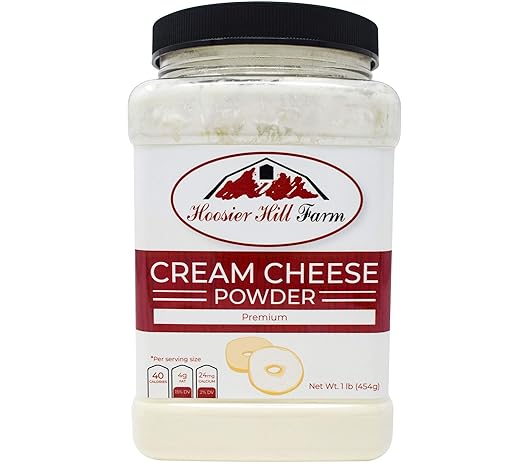
- Cream cheese powder, like this one from Hoosier Farms. On a scale of 1 to 10, with 1 being "somebody's trying to poison me" and 10 being "go away, I'm eating this cheesecake by myself", this product, mixed exactly according to directions on the package rates a solid 1. It was runny. I couldn't even ask my family to try it. It was so, so, so nasty.
- Cream cheese powder, the same from above, but mixed with homemade plain yogurt instead to thicken it up and maybe improve flavor and mouth feel. On the same scale of 1 to 10, this rated a 2. It was thicker but still had an off taste to it.
- One person on a preparedness forum indicated that she added one tablespoon of butter powder per cup of yogurt to make a cream cheese substitute very similar to Philadelphia cream cheese. I think she hasn't bought Philadelphia cream cheese or any brand of cream cheese in a very long time. It tastes ok, meriting perhaps a 4 or 5. Members of my preparedness class tonight thought it would work as a base for a chip dip, with the right herbs. It was definitely nothing like cream cheese.
- Cream cheese substitute from plain yogurt. Per numerous recommendations online, I drained and salted some of my homemade yogurt. I think I'd give this a 5 as well, better than the others, but nothing you'd want to eat a lot of.
- My fifth and final attempt at making cream cheese from food storage items involves the recipe below, the ingredients and instructions for which come exactly from Bigger, Bolder Baking. However, I did adapt the ingredients to using a whole milk substitute that is completely from food storage. Like the others, this did not turn out well, either. To be fair, I am using a whole milk substitute. Also, from what I have read from other sources, cream cheese is much easier to make and tastes better when the milk is not homogenized, and most store-bought milk is.
For me, right here and right now, I'm giving up. I think I will not pursue the quixotic quest for cream cheese any further. At least, for now. Maybe we should just get some goats.
Bigger, Bolder Baking's Homemade Cream Cheese
Ingredients
- 4 cups (32oz /1000ml) whole milk (full fat, not low fat) (1 1/3 cups p milk plus water to make full quart. 4 teaspoons honey, 1/4 cup butter powder
- 2-3 tablespoons lemon juice (lime juice or white vinegar)
- 1/4 - 1/2 teaspoon salt (read notes)
Instructions
-
In a heavy-bottomed saucepan, heat the milk on med-high. Stirring constantly until it starts to a rolling simmer.
-
Reduce the heat to medium. Add the lemon juice 1 tablespoon at a time, in 1-minute intervals. Continue stirring constantly.
-
Continue cooking until the mixture curdles. Stir constantly till the mixture has separated completely, this should take just a few minutes. There will be a green liquid on the bottom and thick curdles on top. Remove from the heat. This should happen within a few minutes.
-
Lay a sieve with cheesecloth over a large bowl. Pour the curd mixture into the sieve. Let it strain and cool for about 15 minutes.
-
Transfer curds to a food processor and process until curds have come together and are totally smooth and creamy. It will take around 3-4 minutes. Keep going if your cream cheese is grainy.
-
Add salt and taste. Add more if you want more flavor. Now is also a good time to add herbs, garlic or any other flavors you like.
-
This cream cheese must be stored in the fridge. I always use it within 7 days but can last as long as up to 2 weeks.
Links to related posts:
Making Thick and Creamy Yogurt
For further reading:
https://www.biggerbolderbaking.com/how-to-make-cream-cheese/
http://preparetodaywardnewsletter.blogspot.com/2014/09/my-food-storge-week-in-review-yogurt.html
© 2019, PrepSchoolDaily.blogspot.com

My hopes are dashed.
ReplyDeleteWife makes fantastic 'bagels' from cream cheese and other stuff that are very low carb and border on delicious (okay a solid 5-6-/10, or better depending on what you put on them) and the lack of a storable cream cheese has been on our mind.